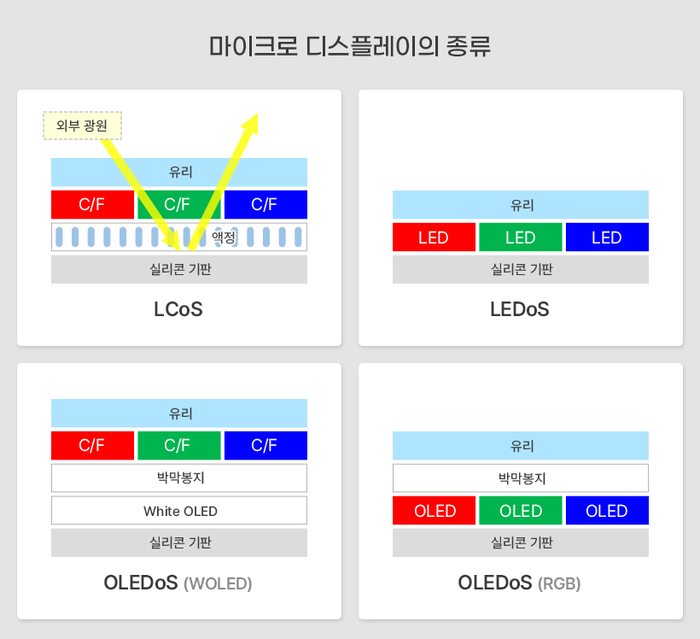








Samsung Display is moving ahead with equipment investments for RGB OLEDoS (OLED on Silicon), a next-generation microdisplay technology. As RGB OLEDoS has yet to be commercialized, industry attention is focused on whether the company can successfully bring the technology to market.
According to industry sources on June 11, Samsung Display is currently in discussions with equipment suppliers as it prepares to place orders for RGB OLEDoS production equipment in the second half of this year.
The plan centers on establishing a dedicated production line equipped with OLEDoS deposition systems. Equipment orders are expected to be placed later this year, installed in 2027, and used for mass production beginning in 2028.
One of the key decisions will be the selection of a deposition equipment supplier. Industry observers expect Samsung Display to choose among South Korea's Sunic System, CIS, and Japan's Canon Tokki.
A display industry source said Samsung Display is considering an RGB OLEDoS deposition line featuring more than a dozen chambers. The source also expects the company to adopt tandem technology, which stacks multiple emissive layers to enhance performance. In deposition equipment, chambers serve as the main units where organic materials are deposited and transported during panel manufacturing.
OLEDoS is an ultra-high-resolution, ultra-lightweight display technology, typically measuring around one inch in size. It is manufactured by depositing organic materials onto silicon wafers and is regarded as a critical component for next-generation augmented reality (AR) and extended reality (XR) devices.
There are two primary OLEDoS architectures: White OLED and RGB OLED. White OLEDoS uses white OLED emitters combined with color filters, whereas RGB OLEDoS directly deposits separate red, green, and blue light-emitting materials.
Because RGB OLEDoS does not rely on color filters, it can minimize light loss and deliver superior brightness and power efficiency. However, commercialization has been challenging due to the need for highly advanced manufacturing processes, including extremely fine masks and alignment precision below one micrometer.
As a result, all commercially available OLEDoS products today use the White OLED approach. The industry is closely watching whether Samsung Display can overcome these technical hurdles and become the first company to commercialize RGB OLEDoS technology.
An industry insider noted that Samsung Display appears to believe deposition equipment alignment technology has advanced sufficiently to support investment in RGB OLEDoS production facilities.
Earlier, in 2023, Samsung Display acquired U.S.-based RGB OLEDoS specialist eMagin for approximately KRW 290 billion (about $218 million) to strengthen its technology portfolio. At CES earlier this year, the company also unveiled an RGB OLEDoS prototype featuring a resolution of 5,000 pixels per inch (PPI).