








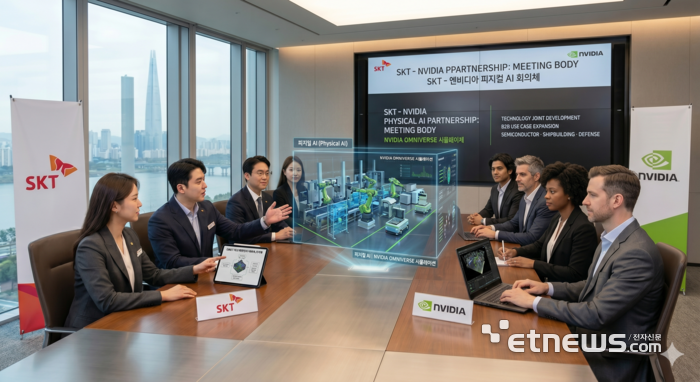
SK Telecom and Nvidia have launched a regular working group aimed at accelerating the development and commercialization of Physical AI technologies, expanding their collaboration to industrial and manufacturing sectors both in South Korea and globally.
According to industry sources on June 3, the two companies formed the joint task force following discussions held at Nvidia's GTC 2026 conference in March.
The collaboration framework consists of two tracks: executive-level meetings involving senior management from both companies to discuss strategic initiatives and business opportunities, and working-level sessions focused on solving technical challenges and jointly developing digital twin platforms based on Nvidia Omniverse technology. The companies have agreed to hold the meetings on a regular basis to strengthen cooperation.
The partnership has already begun to take shape. Nvidia's Omniverse specialists recently visited SK Telecom's headquarters in Seoul to conduct technical workshops, underscoring the growing depth of the collaboration. During Nvidia GTC Taipei this month, SK Telecom was also introduced as one of Nvidia's key partners in the manufacturing Physical AI sector.
Internally, SK Telecom has completed preparations to accelerate its Physical AI business. The company established a dedicated Physical AI division under its AI Company-in-Company (AI CIC) structure during a corporate reorganization last September. Led by Executive Vice President Cho Ik-hwan, the 60-member team is responsible for developing and commercializing digital twin technologies, robot training platforms, and AI data solutions for manufacturing environments.
Physical AI, as envisioned by SK Telecom, integrates decision-making and operational execution for large-scale industrial facilities using virtual environments. At the center of the initiative is the combination of Nvidia Omniverse-based digital twin platforms and advanced robot learning systems.
SK Telecom's digital twin technology creates detailed 3D virtual replicas of manufacturing facilities, production processes, and logistics operations. Companies can use these virtual environments to test new production lines or process changes through simulation before implementing them in the real world.
The platform also serves as a training ground for robots. Before deployment in actual factories, robots can undergo tens of thousands of simulated training iterations within the virtual environment. Through this process, Robot Foundation Models (RFMs) can be fine-tuned to meet the specific requirements of different industries, effectively creating customized AI-powered robotic systems.
SK Telecom is currently conducting proof-of-concept (PoC) projects with several affiliates, including the application of digital twin technology to semiconductor manufacturing processes at SK Hynix. The two companies aim to establish an autonomous semiconductor fabrication facility by 2030.
“We plan to continue developing use cases based on our proof-of-concept experiences, particularly in industries with highly complex processes and significant operational risks, such as semiconductors, shipbuilding, and defense,” an SK Telecom spokesperson said.
The company added that it intends to expand Physical AI applications beyond manufacturing into logistics, services, and other industrial sectors, positioning the technology as a key growth business in the years ahead.
