








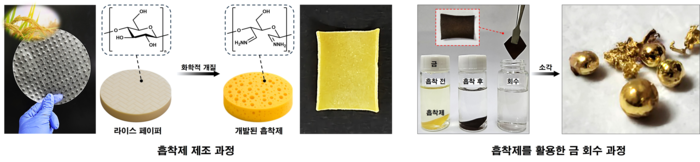
Researchers have developed a technology that converts rice paper, a common food material, into a high-performance and environmentally friendly adsorbent capable of efficiently recovering gold from wastewater through a simple chemical modification process. Compared with conventional petroleum-based adsorbents, the new material is easier to manufacture and more sustainable, making it a promising solution for industrial wastewater treatment and precious metal recovery from electronic waste.
The National Research Foundation of Korea (NRF) announced on June 15 that a research team led by Lee Jeong-hyun at Korea University had developed an adsorbent derived from rice paper that can selectively capture gold ions from wastewater.
Gold is an essential industrial resource, but its limited natural reserves have increased the importance of recovering the metal from waste streams. Existing adsorption-based recovery technologies often rely on large amounts of organic solvents and petroleum-derived chemicals, creating environmental concerns. In addition, powdered adsorbents can be difficult to collect after use, while bio-polymer-based alternatives typically require complex cross-linking processes to maintain their structure in water, reducing their economic viability.
To overcome these limitations, the researchers focused on rice paper, which is already manufactured in thin-film form and therefore does not require additional shaping or molding processes.
Using an environmentally friendly water-based process instead of organic solvents, the team chemically modified starch-based rice paper to give it a strong affinity for gold ions. The resulting adsorbent demonstrated excellent mechanical stability in water and possessed a porous structure, enhancing its suitability for real-world industrial applications.
When tested in acidic wastewater generated from electronic waste recycling, the material selectively captured gold ions while excluding other metals. This performance was achieved through a combination of electrostatic attraction and chelation, a process in which metal ions form stable ring-like complexes with multiple binding sites on organic molecules.
Notably, the adsorbent was able to spontaneously reduce a portion of the captured gold ions into gold nanoparticles, further improving both recovery efficiency and selectivity. After adsorption, high-purity gold could be obtained through a simple calcination process, in which the material is heated at high temperatures to remove unwanted components and retain the target substance.
Professor Lee stated, “We have developed a high-value adsorbent using inexpensive, environmentally friendly biomass-based materials and processes. We plan to continue exploring various biomass resources for the recovery of precious metals and rare earth elements.”
The findings were published online on May 27 in the journal Proceedings of the National Academy of Sciences.
