







The Korea Power Exchange (KPX) has unveiled a next-generation Energy Management System (EMS) applied with artificial intelligence (AI). KPX opened an era of future-oriented power grid operations by establishing a redundant control system capable of stably operating the national power grid even under disaster and catastrophe situations, while simultaneously introducing the '2nd-Generation K-EMS' which significantly strengthens renewable energy generation forecasting and automatic generator control functions.
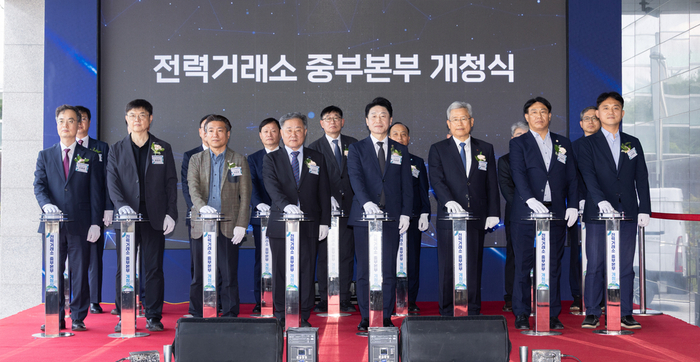
On the 15th, KPX held the opening ceremony for its Central Headquarters built in the Osong Biopolis in Cheongju-si, Chungcheongbuk-do. The opening of the Central Headquarters was designed to commemorate the establishment of the mainland redundant power control center and the commencement of operations for the next power Energy Management System (EMS) and Market Management System (MMS), and it was pushed forward to secure an uninterrupted power grid and power market operation system even during disaster situations.
The Central Headquarters was built in the area of Bongsan-ri, Osong-eup, Cheongju-si, Chungcheongbuk-do, with a total floor area of 7,840 square meters and a scale of four stories above ground. A total project cost of approximately 37.7 billion won was invested, and the building obtained a 1++ grade in building energy efficiency and a 4th grade as a zero-energy building.
The background behind KPX embarking on the construction of the Central Headquarters lies in the strengthening of power grid stability. After experiencing an incident in 2017 where a redundant power control center was flooded due to a landslide in the Cheonan region of Chungcheongnam-do, KPX started preparing measures to secure the continuity of national power grid operations.
A redundant power control center and market management system have been established at the Osong Central Headquarters, configuring an always-active redundant (active-active) operation system with the existing Naju Central Power Control Center. It is designed so that even if a failure occurs at one location, the other control center can immediately take over the power grid operation. In particular, it is capable of independent power grid operation even in emergency situations by strengthening power generation and renewable energy control functions.
The next-generation EMS unveiled on this day is evaluated as a symbolic achievement showing the evolution of domestic power grid operation technology. The EMS is a system that operates the power grid by analyzing information on power plants, transmission grids, and power demand across the country in real time, and it is called the 'brain of the power grid.'
South Korea secured the original technology for EMS for the fifth time in the world through government-led industry-academia-research joint research in 2014. In 2023, KPX embarked on the next-generation EMS construction project together with LS ELECTRIC, KDN, and the Korea Electrotechnology Research Institute (KERI), and showcased the 2nd-Generation K-EMS along with this opening of the Central Headquarters through a development and verification process spanning about three years.
The core of the 2nd-Generation K-EMS is the strengthening of renewable energy response capabilities. By utilizing AI, it can forecast the amount of renewable energy generation included in thousands of power loads and analyze generation volatility up to six hours later. Furthermore, by applying high-speed optimization technology, it automatically controls hundreds of generators and also possesses a regional power pricing calculation function that reflects the locations of power sources and power consumers.
In response to the expansion of renewable energy, KPX plans to strengthen the operation and output control functions of non-centralized dispatch generators and continuously expand integrated control capabilities based on weather information and demand forecasting. Its blueprint is to utilize this as a core infrastructure to respond to the rapidly changing power environment, such as the proliferation of AI data centers, increased power demand due to electrification, and the expansion of renewable energy.
Kim Sung-jin, chairman of KPX, said, “The Central Headquarters is a core infrastructure for securing the stability and continuity of national power grid operations,” and added, “Based on the redundant control system between the central and central-regional headquarters, we will do our best for stable power grid operation and the expansion of renewable energy acceptance.”
