

Inkjet Printing Technology Takes Center Stage
Pilot Production Line Under Discussion With Partners
Competition With LG Display's Photopatterning Technology
Materials, Equipment and Yields Key to Success

Samsung Display is entering the competition to develop red, green and blue (RGB) organic light-emitting diode (OLED) technology that does not use fine metal masks (FMMs), focusing on inkjet-printed OLEDs.
Competition in FMM-free OLED technology is expected to intensify as Samsung Display joins LG Display, which has officially announced the development of another FMM-free technology called FLIP (photopatterning), and Chinese companies investing in related production equipment.
According to industry sources on Oct. 19, Samsung Display has begun discussions with its partners on establishing a pilot production line for inkjet-printed OLEDs.
“Samsung Display is reviewing the possibility of establishing an inkjet OLED pilot line,” a source familiar with the matter said. “Among the FMM-free technologies the company has been researching, it has selected inkjet printing as its focus and is accelerating development.”
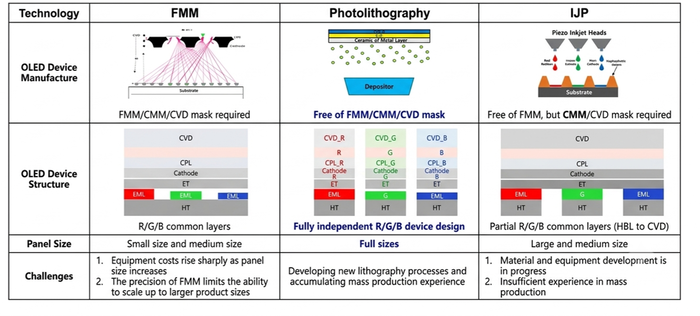
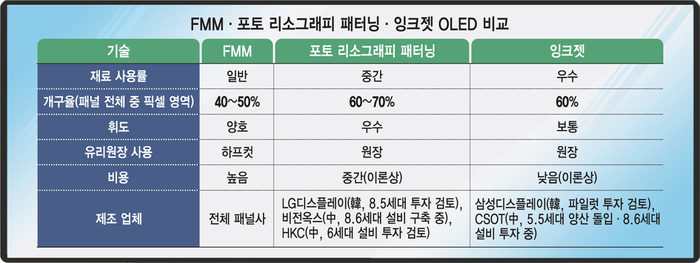
An FMM is a component made from a thin metal sheet with extremely fine holes that allow organic materials to be deposited at precise locations. Until now, the only commercialized method for mass-producing RGB OLEDs has involved the use of FMMs. However, the FMM process has limitations, including difficulties in producing larger panels and high consumption of expendable components and light-emitting materials.
Inkjet OLED technology uses inkjet printing to form pixels from RGB organic light-emitting materials. Because pixels can be printed directly without using masks, the manufacturing process is relatively simple and consumes fewer expendable materials. If stable production yields can be achieved, manufacturing costs could theoretically be reduced by more than 30%.
Although specific applications for inkjet OLED technology have not yet been determined, the technology is expected to be used initially in information technology (IT) panels for devices such as laptops and monitors.
Samsung Display has spent several years researching not only inkjet OLED technology but also photopatterning technology under the name Micro Patterned OLED (MPO). The move to establish a pilot production line is seen as an effort to advance inkjet OLED development beyond the laboratory research stage.
Samsung Display has accumulated experience with inkjet processes through their application to quantum dot (QD)-OLED, its large-screen OLED technology. QD-OLED uses inkjet printing to deposit a QD color conversion layer on top of an OLED light-emitting layer formed through conventional thermal evaporation, improving color purity. Samsung Display is believed to be seeking new opportunities by applying this experience to inkjet OLED technology.
Samsung Display's efforts to accelerate inkjet OLED development through preparations for a pilot production line come amid intensifying competition in the display industry to form RGB OLED pixels without FMMs.
LG Display and China's Visionox are preparing investments in or building equipment for photopatterning-based OLED production. China's TCL China Star Optoelectronics Technology (CSOT) recently began mass production of laptop and monitor panels using fifth-and-a-half-generation (Gen 5.5) inkjet OLED equipment. The company is also investing in Gen 8.6 production equipment.
“South Korean display companies have begun seriously pursuing FMM-free OLED technologies that were previously explored mainly by Japanese and Chinese companies,” an industry official said. “The biggest factors determining competitiveness will be securing materials, components and equipment technologies suited to the new processes, as well as achieving production yields that provide an advantage in mass manufacturing.”