








KT announced on June 21 that it had unveiled its future network security vision, “E2E Quantum Security” (End-to-End Quantum Security), during a special session at the Summer Conference of the Korean Institute of Communications and Information Sciences (KICS).
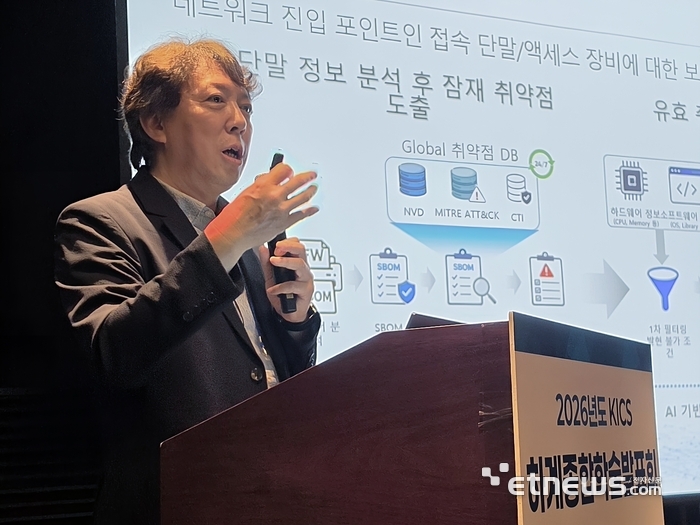
The event was an academic conference where experts from industry, academia, and research institutions shared the latest ICT research achievements and innovative technologies. It was held from June 17 to 19 at the Haevichi Hotel & Resort. KT's special session took place on June 19 and was presented by Jeong Jemin, Executive Vice President and Head of Network AI Research at KT.
During the presentation, KT explained that AI technologies are increasingly being used for vulnerability detection and attack automation, while self-evolving attack methods are reshaping traditional network security paradigms. KT emphasized the need for next-generation security frameworks capable of responding to these emerging threats.
KT also emphasized that advances in quantum computing technology could undermine the security of existing public-key cryptography systems. In a public-key cryptography system, anyone can encrypt data, but only authorized users can decrypt it. Traditionally, even if hackers stole encrypted data, they could not decipher it. However, quantum computers may eventually be capable of breaking such encryption.
To address these emerging threats, KT introduced its “E2E Quantum Security” strategy. This is KT's vision for future network security, applying quantum technologies across key infrastructure components, including data transmission paths, network equipment, AI data centers, and cloud environments.
E2E Quantum Security is built on three core pillars △Quantum Link: Protects data transmission between customers and communication networks △Quantum Node: Detects and safeguards against vulnerabilities and anomalies in network equipment and operational environments △Quantum Vault: Protects the entire data lifecycle--from creation and storage to utilization and deletion.
Through this framework, KT aims to establish an integrated security system that protects every layer of the network ecosystem, from transmission channels and network infrastructure to data itself, while enhancing both cyberattack response capabilities and overall security resilience.
In addition to AI and quantum security, KT's special session also addressed security issues related to telecommunications network operations. Discussions covered security vulnerabilities and wireless attack techniques in 5G and LTE mobile networks, security challenges in device, wireless protocol, and service configuration processes, zero-trust security architectures, and security strategies for telecommunications operators in the AI era.
Lee Jong-sik, Executive Vice President and Head of KT's Future Network Lab, said “This special session provided a valuable opportunity to share AI-driven security technologies and KT's vision for future network security in response to increasingly sophisticated cyber threats. Leveraging our expertise in AI and quantum technologies, we will continue to strengthen the stability and reliability of future networks.”
