









Trump Signs 'Operational Deployment by 2028'
China Increases Investment Volume Led by Government
Korea to Develop 1,000-Qubit Class Within 6 Years
“International Cooperation and Domestic Ecosystem Creation Needed”
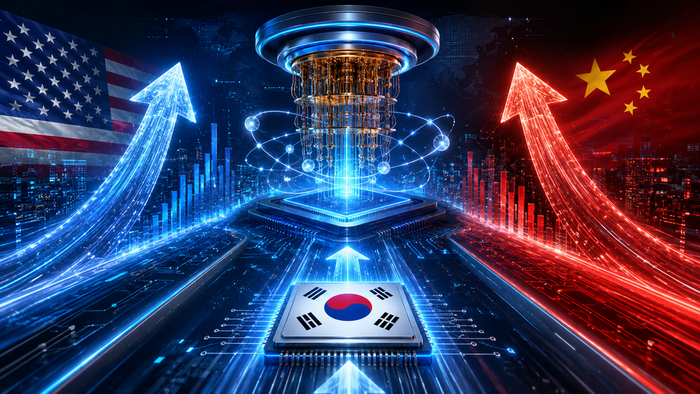
The United States has stepped up national-level support to advance the operational deployment of quantum computers. This is a response to China's continued large-scale investment in quantum technology led by its government. Following artificial intelligence (AI), the rivalry between the US and China for quantum computing hegemony appears to be intensifying. Experts point out that South Korea also needs to speed up its quantum response.
Donald Trump, president of the US, signed two executive orders on the 22nd (local time) containing quantum technology development and security enhancement.
The White House ordered federal agencies to collaborate with companies and universities to commence the development of quantum computers for scientific research. The target development timeline is reported to be 2028. Additionally, Trump instructed the Department of Defense to develop quantum sensors usable even in battlefields where the Global Positioning System (GPS) is jammed.
To counter quantum computer-based attacks, the schedule for the federal government's transition to post-quantum cryptography (PQC) was also specified. Federal agencies must transition key setting functions of critical assets and high-risk information systems to PQC by the end of 2030. Digital signature systems are required to be changed by the end of 2031. He also requested each agency to designate a transition manager and establish detailed implementation plans.
Developing a fault-tolerant quantum computer by 2028 is a schedule one year faster than IBM's previous plan of 2029.
The executive orders did not include specific performance specifications such as the number of qubits and error rates. Regarding this, the Department of Energy is scheduled to prepare technical requirements within 90 days.
The Trump administration explicitly stated as the policy background in these executive orders that the US must maintain its dominance in quantum technology competition against hostile nations (China).
In fact, China is aggressively investing in the quantum field. The 15th Five-Year Plan (2026~2030), finally adopted at the Two Sessions last March, designated quantum technology (quantum computing, communication, and sensing) as the highest priority among the seven major future industries. It clearly presented goals to develop special-purpose quantum computers and fault-tolerant quantum computers.
Private investment in the quantum sector within China is also accelerating. Financing in the quantum technology sector in the first quarter reached 3.2 billion yuan, a 300% increase year-on-year. This is a level exceeding last year's total of 2.473 billion yuan.
As the US and China accelerate their competition pace with national-level investments and specific development goals, voices are raising that Korea should re-examine its response strategy while giving weight to various policies and systems currently being pursued.
Kim Jae-wan, national task researcher at the Korea Research Institute of Standards and Science (chair of the Future Quantum Convergence Forum), emphasized, “Quantum is a field with a technology readiness level (TRL, highest stage 9) at the 3rd to 4th stage level, meaning there are still many potential opportunities for Korea,” and added, “The government must strive for international cooperation and domestic ecosystem creation so that technology development can be accelerated.”
The Korean government is pursuing a plan to develop a 1,000-qubit class quantum computer by 2032 and to transition the existing public key-based cryptography system to a PQC system by 2035. However, compared to the US and China, there are limitations in leaping to the global quantum top 3 level in terms of capital and manpower. Accordingly, advice is given that expanding international cooperation and preoccupying standards are necessary.
Kim, researcher, said, “It is realistically difficult to catch up with IBM, Google, etc., in a short period, but research and development must not be given up as the peripheral technologies and industrial ecosystem accumulated during the quantum computer development process can lead to future competitiveness.”
