








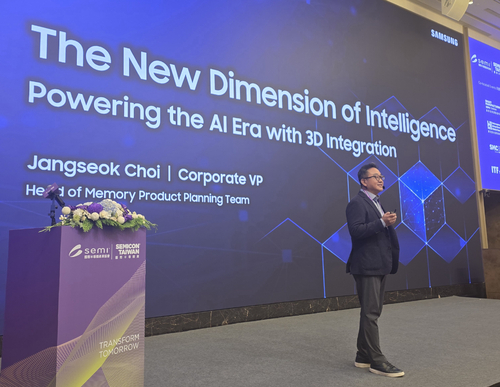
Samsung Electronics aims to double the performance of its next-generation high-bandwidth memory (HBM), HBM5, compared to HBM4E, and further elevate zHBM—its subsequent generation—to eight times the performance of HBM4E. The company is leveraging 3D structural innovation to secure leadership in next-generation memory.
Choi Jang-seok unveiled this next-generation memory strategy during his keynote speech at the 'Memory Executive Summit' held at SEMICON Taiwan 2024 in Taipei, Taiwan, on the 1st.
For HBM5, currently under development, Samsung targets a 2x performance improvement over HBM4E, a 20% increase in performance per watt, and a 20% reduction in thermal resistance to meet AI accelerators' demands for high performance and low power consumption.
zHBM, designed for the post-HBM5 era, will push performance even further. Samsung aims for zHBM to achieve 8x the performance and 3x the performance per watt of HBM4E, with plans to reduce thermal resistance by 75-90%.
The company is also advancing zNAND-O, targeting large-capacity memory needs for large language models (LLMs). zNAND-O aims to increase bit density 10x compared to DRAM while improving read bandwidth and power efficiency by 7x over NAND. Samsung plans to begin zNAND-O sampling in 2028.
Samsung has formalized its next-generation memory development direction under the 'CUBE' strategy.
CUBE stands for △Capacity (capacity) △Utilization (optimization) △Bandwidth (bandwidth) △Efficiency (power/thermal efficiency). Beyond simply stacking memory vertically, the core focus is on simultaneously enhancing capacity, bandwidth, and power/thermal efficiency through 3D structures.
Samsung plans to expand its product lineup—from general-purpose DRAM and NAND to HBM, enterprise SSDs, and next-generation zHBM and zNAND-O—to strengthen its leadership in the AI memory market.
Choi emphasized, “The ultimate goal of 3D is to reduce the energy required to move a single bit of data. We are maximizing performance per watt by enhancing structural efficiency.”
SEMICON Taiwan, organized by the Semiconductor Equipment and Materials International (SEMI), is a global semiconductor event taking place from the 2nd to the 4th.
