








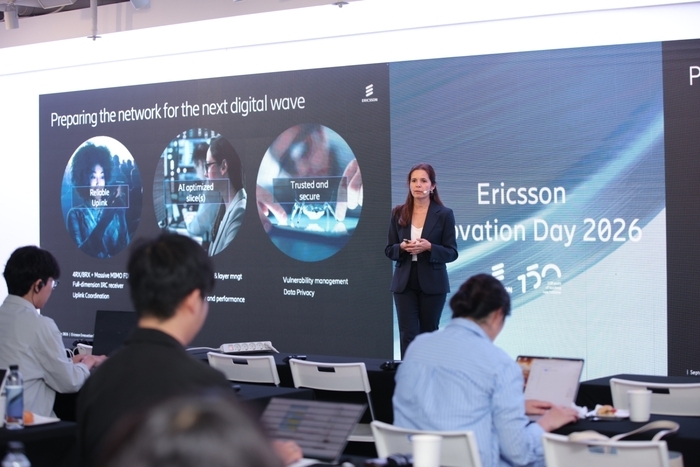
Ericsson said operators must strengthen 5G Standalone and 5G Advanced networks before moving to 6G, using technologies such as AI-RAN, network slicing and integrated sensing to create new revenue opportunities.
At Ericsson Innovation Day 2026 Korea in Seoul on Sept. 1, Ericsson Korea outlined its strategy for 5G SA, AI-driven networks and the transition to 6G. The company said 6G will not emerge as a clean break from current networks; instead, it will evolve step by step from upgraded 5G infrastructure.
Sibel Tombaz, CEO of Ericsson Korea, said the next three years would see network technology evolve faster than in previous cycles.
“Technological requirements such as AI-RAN will be optimized, enabling AI inference across a wide range of applications before the arrival of 6G,” Tombaz said. “To prepare for that evolution and scale more flexibly, technologies such as 5G Standalone and 5G Advanced must provide the foundation. We will support Korea's goal of making 2030 the first year of 6G commercialization.”
Ericsson expects existing network equipment to be upgraded through software, enabling operators to introduce 5G SA and 5G Advanced features before transitioning to 6G. The company argues that this approach will allow existing 5G investment to remain useful as networks become AI-native.
Lee Ji-hyun, head of Network Solutions at Ericsson Korea, said 5G and 6G will be designed for a smooth migration through multi-RAT spectrum sharing, or MRSS. The technology enables 5G and 6G to dynamically share spectrum according to traffic demand and radio conditions, rather than requiring an abrupt replacement of existing network assets.
“6G will not be entirely new,” Lee said. “It will represent the fullest possible evolution of 5G.”
Ericsson also positioned 5G SA as the foundation for new operator business models in the AI era. As physical AI applications such as AI glasses, robots and autonomous vehicles proliferate, networks will need higher uplink capacity, low latency and predictable quality. That could allow operators to move beyond data-volume-based pricing and offer differentiated connectivity with service-specific performance guarantees.
Network slicing is central to that model. Built on 5G SA, it enables an operator to create virtual network segments with different performance characteristics, including latency, uplink speed, reliability and quality of service, for individual applications or enterprise customers.
Ericsson named AI-RAN and integrated sensing and communication, or ISAC, as key technologies for next-generation networks. AI-RAN applies AI across the radio access network to improve network performance, energy efficiency and operational efficiency while delivering the connectivity quality demanded by AI applications. Ericsson defines it as an architecture spanning the RAN, rather than a single product or AI accelerator.
ISAC uses radio signals from a communications network to detect the location and movement of people or objects that are not directly connected to the network. The technology could be used to identify and track drones, vehicles and ships, creating potential business opportunities in defense, public safety, airport protection, logistics and low-altitude aviation services such as drone corridors.
Matteo Fiorani, head of Ericsson's Network Portfolio, said ISAC could detect and track unconnected objects, including drones, ships and vehicles.
“ISAC can create new business opportunities across a wide range of sectors, including defense, public safety and airport protection, logistics, and the low-altitude economy, such as drone highways,” Fiorani said.
