








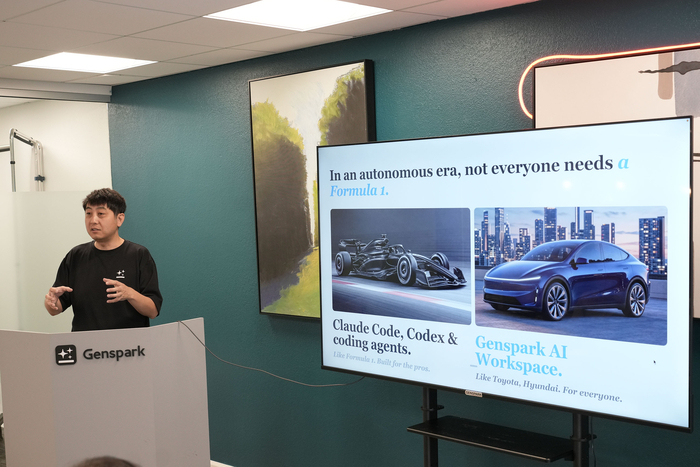
U.S.-based AI startup Genspark has outlined a vision that goes beyond simply providing answers to user queries, positioning “AI that gets work done” as its core mission. As the generative AI market shifts from chatbot-centric services to autonomous AI agents, the company argues that the future winners will be determined not by the underlying AI models themselves, but by how effectively users can achieve real-world outcomes through AI-powered workspaces.
Speaking at a media briefing for Korean journalists at its headquarters in Palo Alto on June 23, Genspark described its product not as a chatbot or search tool, but as an “action-oriented AI workspace.” The company emphasized that its key differentiator lies in transforming user intent into completed work products, enabling AI to execute tasks rather than merely respond to questions.
Founded in Palo Alto in December 2023, Genspark began with its AI search service launched in 2024 and has since expanded its business with the introduction of its “Super Agent” and “AI Workspace” offerings. The company now operates offices in Singapore, Tokyo, and Seoul, and continues to grow its user base across the United States, Japan, South Korea, India, Brazil, and other global markets.
Genspark's AI Workspace is a platform that integrates multiple AI services into a single work environment. Rather than switching between services such as GPT, Claude, and Gemini or managing separate subscriptions, users can access a range of leading AI models and agents from one platform.
The workspace brings together productivity tools including AI Slides, AI Sheets, AI Docs, code generation, design tools, meeting transcription, AI image creation, AI audio, and AI video generation. A key feature is that all functions share data seamlessly, allowing information generated in one tool--such as meeting notes--to be instantly used for spreadsheets, presentations, and other outputs.
During a live demonstration, Genspark CEO Eric Jing showed how a single prompt could generate a complete set of deliverables, including market research reports, presentation slides, images, and even music related to a specific company.
“Most knowledge workers do not need to work directly with code,” Jing said. “Instead of chatting with a chatbot and copying and pasting answers, our approach allows users to interact directly with the work product itself and refine it as needed.”
Interview (Part 1) | CEO Eric Jing: “The AI Revolution Is Only 10% Complete--Soon No One Will Care Whether It's GPT or Claude”
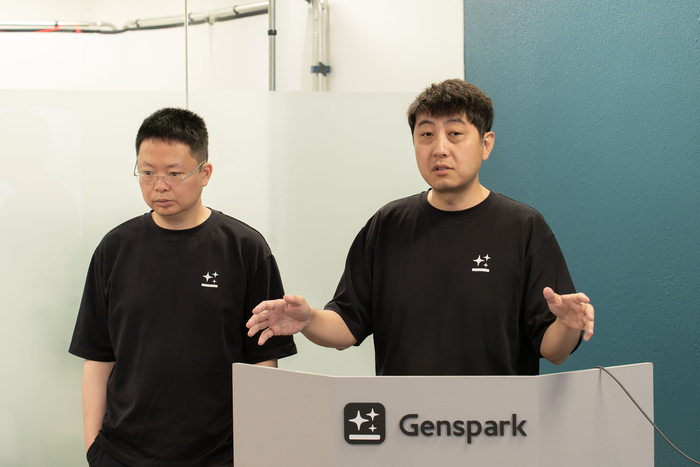
While much of the current AI market is focused on competition among models such as GPT, Claude, and Gemini, Genspark believes that what users ultimately care about is not the model itself, but the outcomes it can produce.
“Most people still use AI as a kind of 'faster Google,' but that represents only a fraction of its potential,” said Eric Jing, CEO of Genspark. “The AI revolution is only about 10% complete today, and the remaining 90% of transformation is still ahead of us.”
Jing argued that the AI industry is evolving from the “chatbot era” to the “copilot era,” and now toward the “autonomous agent era.” He likened first-generation autonomous agents, such as coding agents, to high-performance sports cars. While powerful, they are expensive and require specialized expertise to operate--something most knowledge workers do not need.
“Today, everyone is debating which model is better,” Jing said. “But over time, users will care less and less about the underlying model. What will matter is whether a tool helps them get things done, remembers their context, and delivers more personalized results.”
Summarizing Genspark's long-term vision as “work done by itself,” Jing explained that AI search was built around users asking questions, while AI agents are designed to complete tasks on a user's behalf.
“The future we envision is one where people simply provide context and direction, and the work itself progresses autonomously,” he said.
Interview (Part 2) | CTO Kay Zhu: “Only 0.04% Use Frontier Models--Genspark Chooses the Right Model for Users”
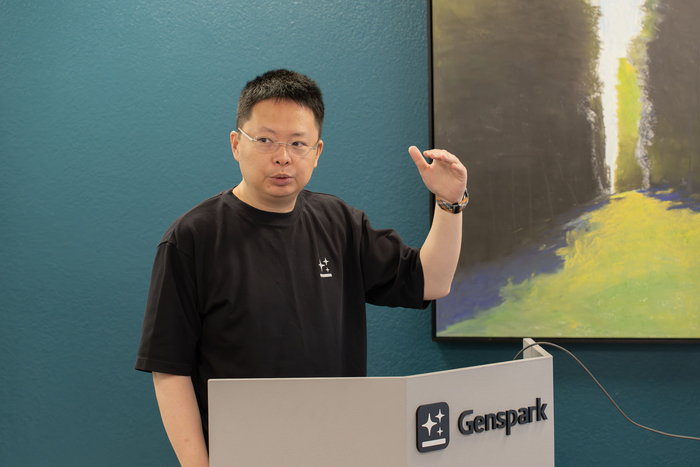
Genspark believes that while new AI models are emerging at an increasingly rapid pace--often every six weeks--most users do not need to keep track of every advancement.
“Model capabilities are improving exponentially, but most people cannot accurately distinguish the differences between them and simply use AI as a faster search tool,” said Kay Zhu, CTO of Genspark. “Only about 0.04% of the population uses frontier capabilities such as coding tools, while the remaining 99.96% do not take advantage of these capabilities at all.”
Zhu argued that typical white-collar workers should not have to follow the evolution of AI models in detail.
“Our role is to determine which model is best suited for a specific task and handle that complexity on behalf of users,” he said.
Genspark currently integrates more than 70 AI models and over 150 tools, including leading language models such as GPT-5.5, Claude Opus 4.8, Gemini 3.5 Flash, and Grok 4.20, as well as image-generation models including Nano Banana Pro and GPT Image 2. The platform also leverages more than 20 datasets. Internally, Genspark operates its own evaluation pipeline to continuously assess which models perform best for different types of tasks.
“For relatively simple tasks such as text summarization, we select fast and cost-efficient models to strike the right balance between quality and cost,” Zhu explained. “For more complex planning and reasoning tasks, we use a mixture-of-agents approach, distributing work across multiple frontier models--including Claude, GPT, and Gemini--and then synthesizing their outputs. This improves accuracy while reducing the risk of hallucinations.”
Palo Alto, USA =
