








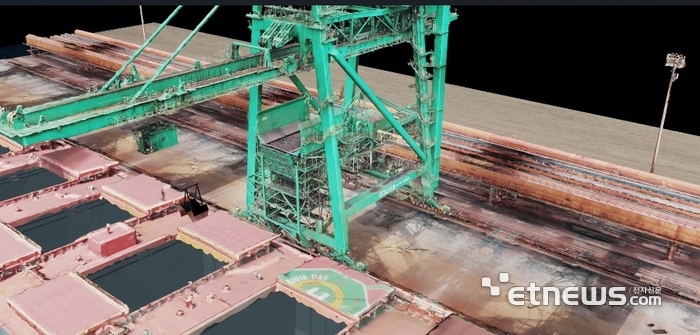
POSCO DX is moving to accelerate on-site deployment of its “Physical AI” solution, which enables industrial facilities and environments to perceive conditions and autonomously control operations. By combining virtual simulation technologies with operational technology (OT), the company aims to advance beyond conventional automation toward the realization of “intelligent factories.”
◇“Precise control of a 45-ton steel mass”… Unmanned autonomous control begins for GTSU
Starting next month, POSCO DX will begin unmanned trial operations applying Physical AI to the “Gantry Ship Unloader (GTSU)” at POSCO's port facilities, as well as a “reclaimer” at the raw materials yard.
The GTSU is used to unload iron ore and coal from bulk carriers of 180,000 to 200,000 tons. The key component is a 20-25-ton grab bucket operated manually by workers from a height of about 50 meters. When filled with raw materials, the total weight reaches 40-45 tons of moving steel mass.
If mishandled and collided with a vessel's hull or walls, it could result in damages and operational losses worth hundreds of billions of won. Using Physical AI's high-precision control technology, known as “anti-sway,” POSCO DX has been able to limit the swing angle of the 45-ton load to around 0.6-0.7 degrees, enabling highly precise autonomous operation that allows the grab to be accurately “thrown” deep into the ship's hold.
The reclaimer, a large excavator used in the raw materials yard, is also undergoing final-stage trial operations in which it autonomously identifies material piles, excavates them, and avoids obstacles.
With Physical AI being introduced into high-risk and high-difficulty processes, the company expects not only to significantly improve worker safety but also to maximize productivity by reducing operational errors caused by manual control.
“Physical AI-based innovation cases have been gradually introduced on site for several years,” said Seok-ju Cho, Head of the AX Convergence Research Center at POSCO DX. “Since last year, more advanced technologies have been continuously deployed in real industrial environments.”
◇Even NVIDIA Was Impressed by Its Virtual Simulation… POSCO DX's Core Edge Lies in 'OT'
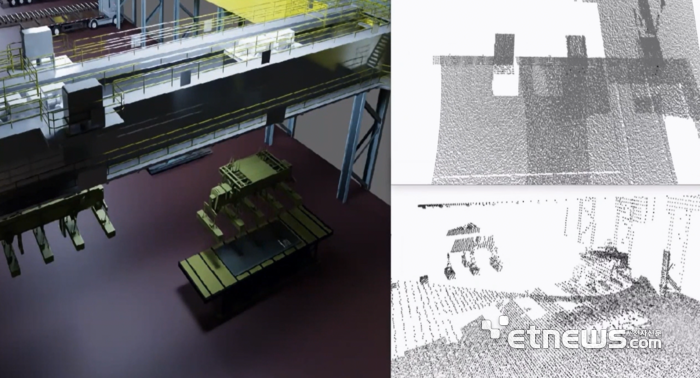
POSCO DX's progress in deploying Physical AI has been achieved through extensive testing of tens of thousands of edge cases within virtual environments. Built on a “digital engine” of virtual simulation, world-class operational technology (OT) expertise has been precisely embedded, enabling AI to fully control industrial equipment and creating a unique competitive advantage.
In manufacturing environments, safety risks and productivity constraints make large-scale real-world experimentation or repeated training virtually impossible. POSCO DX overcame these limitations by using NVIDIA's Omniverse-based “Isaac Sim” platform to replicate real factories in a virtual space.
Data collected from on-site equipment and sensors is used to construct a digital twin that reflects real operating conditions. Within this environment, equipment and operational scenarios are repeatedly trained to develop perception, decision-making, and control logic, continuously improving system performance. The results are then applied to real-world operations, with field data fed back into the simulation to create a continuous learning loop.
One example is the use of quadruped robots deployed in hazardous environments as a substitute for human workers. These robots were developed through a simulation-driven Physical AI process, starting with 3D mapping and the development and validation of SLAM (Simultaneous Localization and Mapping) algorithms before real-world deployment. SLAM enables robots to determine their own location while simultaneously building a map, allowing them to autonomously patrol and monitor high-risk areas that are difficult for humans to access.
A similar case is the unmanned crane system at POSCO Steelion's galvanizing plant. POSCO DX identified optimal sensor placements in a virtual environment, cutting the number of cameras in half while improving accuracy by more than 80%. NVIDIA reportedly described the system as a “top 5% global-level advanced application,” highlighting its highly precise replication of real-world conditions in simulation.
“The key strength of POSCO DX lies in its integrated capability to deeply understand OT in manufacturing environments and combine it with AI for autonomous control,” said Cho. “Beyond simple data analysis, this capability enables AI to directly perceive and precisely operate industrial equipment, serving as a core driver of our technology.”
◇The Key to Manufacturing Survival: Turning Veterans' 'Tacit Knowledge' into a Permanent Asset
POSCO DX laid the foundation for manufacturing innovation through early 2000s process automation in steel plants and its transition to smart factories in 2016. Building on its accumulated digital transformation capabilities, the company is now focusing on developing intelligent factory technologies powered by Physical AI.
This technological advancement is closely tied to manufacturing survival strategies. Improvements in operational efficiency and safety are no longer optional goals but essential factors determining a company's competitiveness and long-term viability.
POSCO DX is also working to convert the “tacit knowledge” of highly skilled workers into core data for Physical AI systems. While current steel plant operations are already 85-90% automated, the remaining 10-15% of unexpected situations still rely heavily on the experience and judgment of veteran workers. As the inflow of younger workers declines and experienced operators approach retirement, failure to preserve and embed this tacit knowledge into AI systems could lead to a loss of manufacturing competitiveness.
“The key to Physical AI adoption is filling the remaining 15% of operational gaps that cannot be defined by rules after automation,” said Cho. “Our ultimate goal is to transfer expert know-how into AI so that advanced operations can continue seamlessly without interruption.”
He added, “Based on the expertise accumulated in world-class manufacturing environments, we aim to establish a new standard for next-generation intelligent factories where human intuition and physical control are fully integrated.”
