








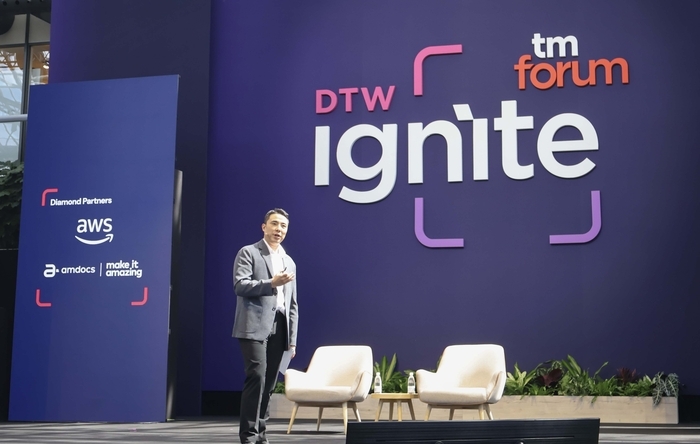
SK Telecom (SKT) announced on June 25 that it officially unveiled its global-standard-based autonomous networking roadmap at TM Forum's “DTW Ignite 2026” in Copenhagen, Denmark. As a premier global telecom industry association comprising more than 240 carriers, technology companies and software vendors, TM Forum provided an ideal stage for SKT to showcase its detailed, standards-aligned network strategy to the global industry.
Autonomous networking refers to a next-generation operational architecture in which artificial intelligence independently runs and manages network infrastructure with minimal human intervention.
In its presentation, SKT highlighted the critical limitations of earlier autonomous networking approaches to explain its strategic adoption of TM Forum standards. Proprietary implementations tailored to specific vendors or equipment have historically constrained scalability. In addition, domestic operational frameworks have been fragmented by domain, making cross-system interconnection and end-to-end integration a major challenge. For AI to function seamlessly, both systems and data must “speak the same language” through a unified global standard--a prerequisite SKT considers non-negotiable for true autonomous networking.
To drive this transition, SKT has defined four core pillars: redefining operational business processes, building a robust data ontology, migrating to next-generation Operations Support Systems (OSS) and standardizing AI agents.
The telecom giant plans to work closely with global technology leaders, including AWS, across the entire deployment phase. Through this collaborative approach, SKT aims to significantly enhance network flexibility and scalability by enabling a single AI solution to orchestrate and control heterogeneous hardware from multiple vendors.
At the same time, SKT is strengthening its in-house AI Transformation (AX) capabilities to achieve unprecedented operational efficiency and productivity. SKT engineers are currently developing and managing more than 1,000 autonomous networking platforms and AI agents in-house. A prime example is “Spider,” an AI-driven monitoring system that centrally oversees all core network equipment, detects anomalies and automatically recommends remediation steps. By consolidating previously siloed monitoring systems into Spider, SKT has significantly improved both operational efficiency and network stability.
Looking ahead, SKT is accelerating its next-generation OSS migration to achieve Level 4 autonomous networking as defined by TM Forum. At Level 4, human intervention is kept to an absolute minimum, as the system has situational awareness and can make independent, automated operational decisions--paving the way for a more resilient and self-healing network ecosystem.
“Building a global-standard-based autonomous network goes beyond simple technological innovation--it is a paradigm shift that will reshape the entire telecommunications industry,” said Ahn Hong-bum, Vice President and Head of Network AT/DT at SKT. “By aligning with TM Forum standards, we look forward to collaborating with global operators to foster a thriving autonomous networking ecosystem and deliver ultra-reliable, intelligent connectivity to our customers.”
