









A warning has emerged that autonomous replication and adaptation (ARA) phenomena, where AI models self-deploy and spread without human control, could become a reality. Anthropic has raised the possibility of “AI worms” that replicate themselves across internet-connected appliances like smart TVs, ovens, and refrigerators.
In a research report released on the 12th (local time), Anthropic stated, “It may take only a few months before small-scale AI models become capable of self-replication on commercial IoT devices, such as smart ovens or low-cost Android TV boxes.”
The research team successfully linked 15 low-cost Android TV set-top boxes, priced at around $55 each, to distribute and run Google's AI model 'Gemini 4-26B-A4B.' This demonstrated that AI models can be executed by combining the computational power of multiple low-spec devices, even without high-end data center GPUs.
According to Anthropic, such self-replicating AI would be difficult to stop because it operates across numerous dispersed devices, unlike conventional AI services that can be halted by shutting down a few servers. There would be no centralized point to block it.
Anthropic noted that fully self-replicating AI does not yet exist and that the spread rate would likely be slow. However, they highlighted that Zhipu AI's 'GLM-5.2' successfully completed the entire autonomous replication process in a controlled experiment. If small-scale models continue to develop at the current pace, they could reach GLM-5.2's level by the end of this year, enabling direct self-replication within devices.
However, some experts remain skeptical. According to Reuters, Ciaran Martin, former head of the UK's National Cyber Security Centre (NCSC), stated, “The fact that a low-cost TV successfully powered a small-scale model does not necessarily constitute a security crisis,” adding, “It appears to be an interesting technical document with heavy vendor exaggeration.”
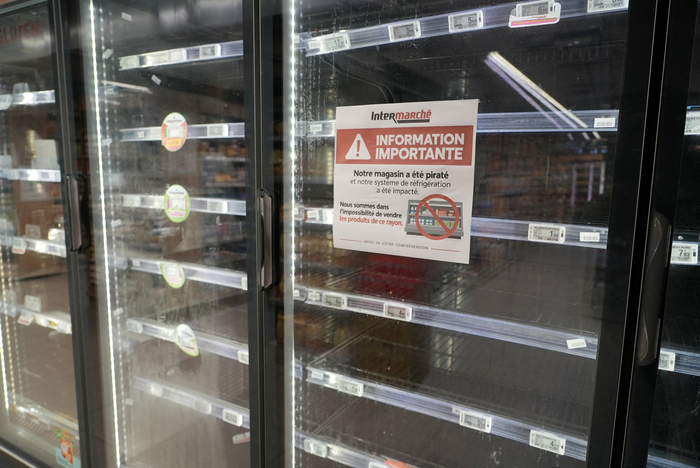
Earlier in France, a remote management system controlling temperatures via the internet was hacked, causing refrigeration and freezing equipment in hundreds of large supermarkets across the country to reach temperatures of up to 50°C, leading to mass food waste.
While there is no evidence that AI was used in this attack, it highlights the security challenges posed by internet-connected devices. Combining existing IoT vulnerabilities with autonomous AI could make cyberattacks significantly more complex.
Meanwhile, CNBC reported that Anthropic will disclose its third-quarter financial status for the first time during a meeting with institutional investors on the 14th. Anthropic submitted a confidential listing application to the U.S. Securities and Exchange Commission (SEC) earlier this year. Reports suggest it could go public in November.
