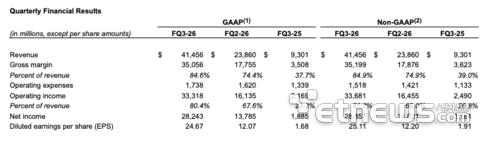








Micron Technology once again underscored the explosive demand for artificial intelligence (AI) chips, posting quarterly results and guidance that blew past Wall Street expectations.
For the third quarter of fiscal 2026, which ended in May, the memory chipmaker reported that revenue and operating income jumped roughly fourfold and fifteenfold year over year, respectively. Quarterly revenue hit a record high of $41.46 billion, up from $9.30 billion in the same period a year earlier. That easily topped the consensus estimate of about $35.6 billion and beat Micron's own prior guidance of $32.75 billion to $34.25 billion. Fueled by this top-line surge, operating income soared to $33.32 billion from $2.17 billion a year earlier.
The stellar performance was driven by booming demand for high-bandwidth memory (HBM) used in AI accelerators and strong sales of data center DRAM. The cloud memory division generated $13.77 billion in revenue, while the core data center business contributed $11.52 billion, meaning data center-related segments accounted for more than half of total sales. Other divisions, including mobile/client ($11.52 billion) and automotive/embedded ($4.63 billion), also reported record quarterly revenue.
Looking ahead, Micron raised its fourth-quarter revenue outlook to between $49 billion and $51 billion, implying roughly 20% sequential growth from Q3. The company expects to set additional records, forecasting a gross margin of around 86% and adjusted earnings per share (EPS) of $30 to $32. For the third quarter, operating cash flow came in at $25.39 billion, while adjusted free cash flow reached $18.30 billion.
Management expects supply-demand conditions for memory--including HBM, DRAM and NAND flash--to remain tight well into 2027 and beyond.
“AI is still in its very early innings, and the performance of AI systems heavily depends on memory capacity, speed and bandwidth,” said Sanjay Mehrotra, Micron's CEO. “The demand trajectory for memory is incredibly strong, cementing its role as a strategic, foundational asset.”
Micron also announced that it has secured 16 long-term supply agreements, ranging from three to five years, with major data center operators and automotive companies to lock in volume commitments.
“Even amid a complex market environment, these strategic partnerships are opening up new growth avenues for Micron,” Mehrotra added. “We expect these agreements to enhance our financial stability and earnings visibility while accelerating our business model transformation.”
With Micron delivering blockbuster results, the broader memory market boom is widely expected to continue. Industry leaders Samsung Electronics and SK Hynix are also projected to post record second-quarter earnings later this month.