








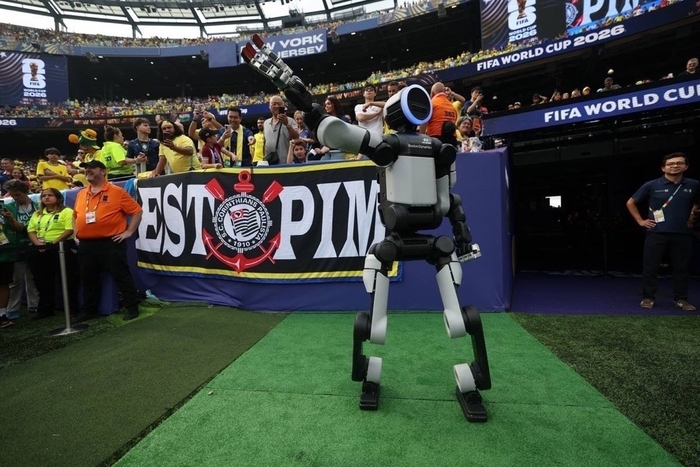
Hyundai Motor Group's humanoid robot, Atlas, successfully pulled off a unique live performance during a Round of 16 match at the 2026 FIFA World Cup.
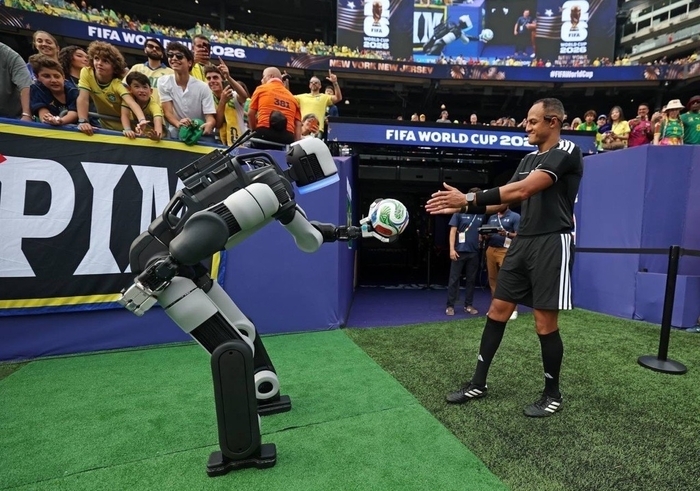
On July 5 (local time), Atlas stepped onto the pitch during the Brazil-Norway match, instantly captivating the crowd by perfectly replicating the iconic goal celebrations of world-class soccer stars, including Son Heung-min, Harry Kane, Erling Haaland, and Matheus Cunha. Following the performance, the humanoid smoothly delivered the official match ball to the referee to signal the start of the second half.
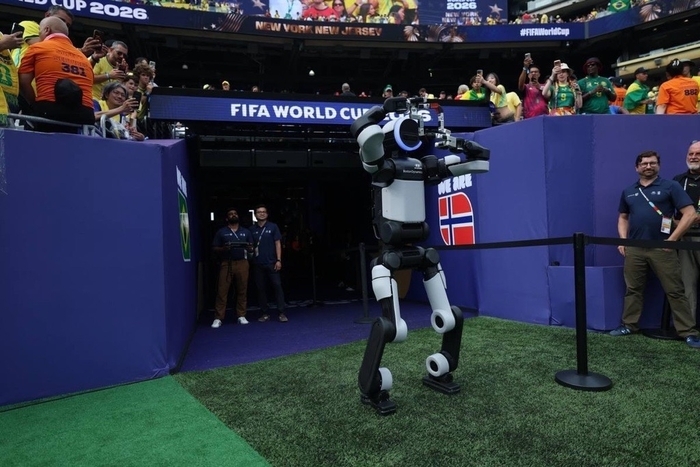
The robot featured in this showcase is the Next-Generation All-Electric Atlas Development Model, which made its global debut earlier this year at CES 2026. While it had previously been teased only in brand videos, the World Cup match marked its very first live, on-site public demonstration.
According to Hyundai, Atlas demonstrated remarkable stability while executing complex, fluid movements in a highly unpredictable stadium environment. The live demonstration effectively showcased Hyundai Motor Group's advanced robotics capabilities, leveraging specialized motion retargeting technology to translate human movements into robotic kinematics, simulation-based reinforcement learning, and whole-body control algorithms that allow all joints to react seamlessly as a single system.
Hyundai emphasized that the core movements performed by Atlas were originally engineered for deployment in real-world industrial environments. Through this World Cup debut, the company aimed to prove that its robotics technology can transcend industrial boundaries to create entirely new experiences in sports, entertainment, and on-site operations.
“Through Atlas's performance at the World Cup, we wanted to demonstrate that the future is no longer just an imagination--it has already begun,” said Sungwon Jee, Senior Vice President and Head of the Brand Marketing Division at Hyundai Motor Company. “We will continue to chart a new vision for future mobility, one that is continuously expanded through robotics.”
