






China's BOE is investing in equipment to expand production of large liquid crystal display (LCD) panels measuring 85 inches and above.
BOE recently released an environmental impact assessment report for an upgrade and refurbishment project at its Gen 8.6 LCD production line at the B19 plant in Chengdu, Sichuan Province. The project involves an investment of CNY 2.827 billion, or approximately KRW 607.7 billion.
The centerpiece of the investment is a shift toward larger LCD panels and the adoption of oxide thin-film transistor (TFT) technology. The maximum panel size produced at the facility will increase from 100 inches to 116 inches, while key specifications—including refresh rate and transmittance—will also be improved.
Previously, the B19 plant used 158,700 glass substrates per month to produce 50- to 58-inch panels, while 4,300 substrates were allocated to ultra-large products ranging from 85 to 116 inches. Under the upgrade plan, capacity equivalent to roughly 60% of the existing 50- to 58-inch production line—96,700 substrates per month—will be converted to produce 85- to 116-inch ultra-large LCD panels using oxide TFT technology.
BOE is also seeking to improve panel performance by replacing conventional amorphous silicon (a-Si) TFTs with oxide TFTs. Compared with a-Si TFTs, oxide TFTs offer higher electron mobility, lower leakage current, lower power consumption, and better suitability for large-area panels.
The move suggests that Chinese panel makers are targeting higher-value opportunities in the saturated TV LCD market by focusing on larger screen sizes and higher performance.
For premium TVs, ultra-large LCD panels are increasingly viewed as a way to differentiate products from organic light-emitting diode (OLED) displays. OLED panels remain costly to manufacture, while larger sizes bring greater process complexity and make it more difficult to achieve high yields. With the Gen 8.5 production lines that remain the industry's mainstream, panel makers must generally stay below 100 inches to maximize the number of panels cut from each glass substrate.
As a result, Chinese manufacturers are seen as pursuing ultra-large LCD panels—which are less costly to produce—as a way to compete with OLED. The TV OLED panel market is currently supplied entirely by South Korean manufacturers.
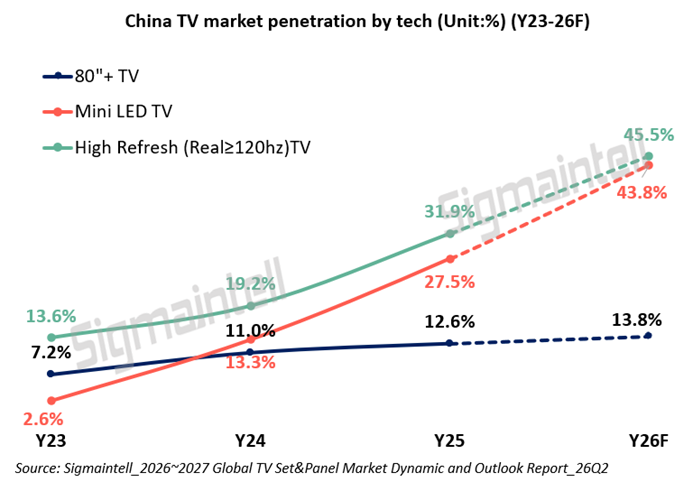
According to market research firm Sigmaintell, TVs measuring 80 inches and above are projected to account for 13.8% of China's TV market in 2026.