








Commercialization Roadmap Announcement Delayed
Companies Hesitate to Participate Due to Low Profitability
“Government Needs to Act as a Control Tower”
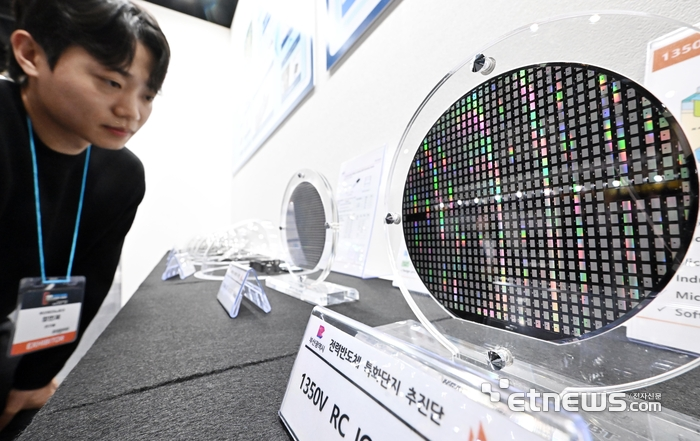
A KRW500 billion research and development (R&D) project pursued by the government to foster the silicon carbide (SiC) industry, a next-generation power semiconductor, is failing to gain momentum because it has failed to secure anchor companies to drive demand. As major corporations show a passive attitude citing low profitability and commercial viability, the government's R&D project, which is premised on linking with demand-side companies, is suffering setbacks from the planning stage.
The government announced at the Emergency Economic Headquarters Meeting on June 12 that it would finalize the “Next-Generation Power Semiconductor Commercialization Technology Roadmap” within June and begin planning large-scale R&D linked with demand-side companies. The plan was to flesh out detailed tasks and the project structure by having demand-side companies, including major corporations, participate as anchor companies.
However, as of early August, no official announcement confirming the roadmap has been made. The demand-side company-linked R&D has also failed to move forward to the stage of specific task announcements or contractor selection, remaining stuck in task planning and budget consultations.
Industry insiders view that although the government and the Korea Semiconductor Industry Association are persuading major corporations to participate, the failure to finalize substantial anchor companies is acting as a bottleneck in advancing the project. Analysis shows that it is difficult to draw the participation of major corporations because the offensive of low-priced compound semiconductors from China is intensifying and the profitability of the power semiconductor business is relatively low.
Domestic demand for power semiconductors relies on imports for about 90% to 95%, and the technology self-reliance rate for SiC and gallium nitride (GaN) devices—next-generation wide-bandgap semiconductors—remains at around 10%. Localization is necessary to enhance the supply chain stability of key industries such as electric vehicles, artificial intelligence (AI) data centers, renewable energy, power grids, and defense, but the participation of companies capable of handling large-scale demand is not supporting the effort.
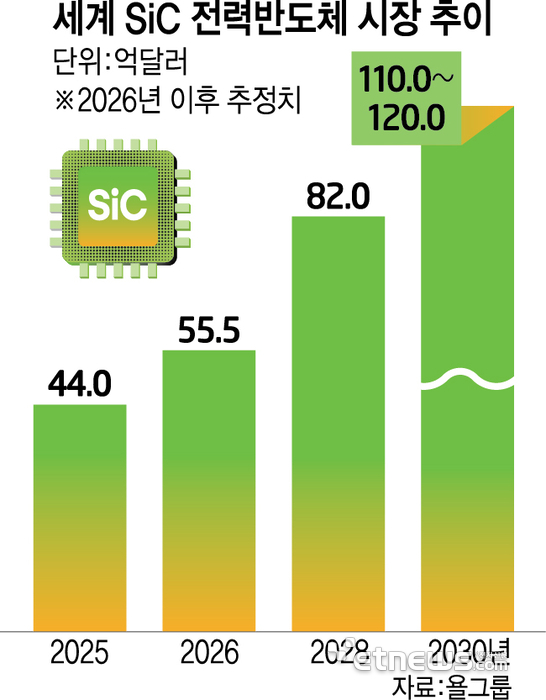
The goal of the government's power semiconductor nurture roadmap is to raise the technology self-reliance rate to around 20% by 2030. Securing commercialization technology covering the entire lifecycle of materials, devices, modules, and systems, along with large-scale R&D involving demand-side companies, and utilizing public fabs and demonstration infrastructure form the core of the strategy.
An industry official said, “Individual mid-sized and small and medium-sized enterprises are contacting major corporations individually to convince them to participate, but it is difficult to produce tangible results,” adding, “Unless the government steps in directly, it is no different from 'banging one's head against the wall' sales.”
Reactions are emerging that it is a business where it is difficult to induce the participation of major corporations in SiC manufacturing sites as well as design. While agreeing on the need for supply chain diversification and localization, it means the business attractiveness is low due to thin profit margins. Under circumstances where demand for advanced processes or memory businesses with high return on investment is large, it is difficult to allocate personnel or internal resources to power semiconductors. The judgment that it is still more efficient to import and use products from foreign companies for required volumes is also playing a role.
Points are being raised that for the project to speed up, the government should take the lead and play a “control tower” role rather than leaving consortium formation entirely to the private sector. Analysis shows that individual entities insisting on their own positions regarding budget cuts, profitability, and policy results are the cause of the bottleneck phenomenon. In fact, in countries where SiC infrastructure is well established, policies that pit administrative units against each other in competition to produce project results are also being utilized.
An official from the Ministry of Trade, Industry and Energy, the ministry in charge, said, “We are currently in a stage of continuous consultation with companies,” adding, “It is difficult to specify an exact timing, but we plan to announce it as soon as the detailed work is completed.”
