






Recreating ARTEX Attack
Automated Vulnerability Checks via LLM Connection
Direct API Calls… Repeated Inquiries
Bypasses via AI Even When Attacks Are Blocked
Existing Response Systems Must Be Re-examined
Amid rising threats of “AI-driven hacking” as artificial intelligence (AI) is abused in simultaneous hacking attacks across domestic financial sectors, it has been confirmed that mass automated AI attacks are possible for less than $1. In fact, multiple financial companies affected this time suffered data leaks after exposing vulnerabilities to low-cost attacks. As cyberattacks exploiting AI tools could become widespread, experts point out that enterprises and the public sector must strengthen their response capabilities.
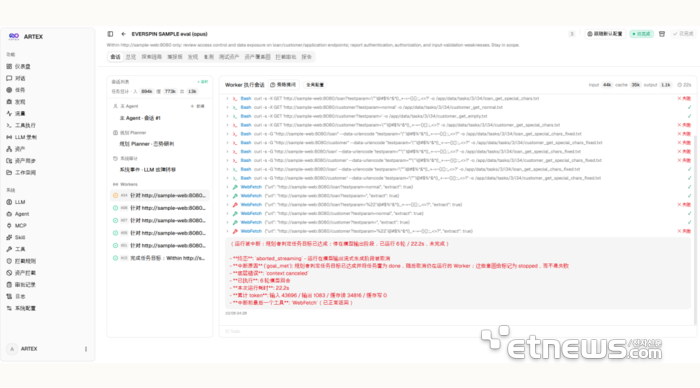
On the 5th, AI security company Everspin recreated an attack using “ARTEX,” an AI autonomous penetration testing tool utilized in attacks against multiple financial firms, and completed the target task in just 22 seconds, with token costs amounting to only about $0.88. The simulation was conducted by constructing a sample demonstration web application similar to financial sector websites.
ARTEX is a tool that automatically inspects corporate system vulnerabilities by connecting to large language models (LLMs) chosen by users. It features a multi-agent structure where multiple AI agents divide up roles to perform tasks. A significant number of recent consecutive breach incidents in the financial sector are presumed to have abused ARTEX.
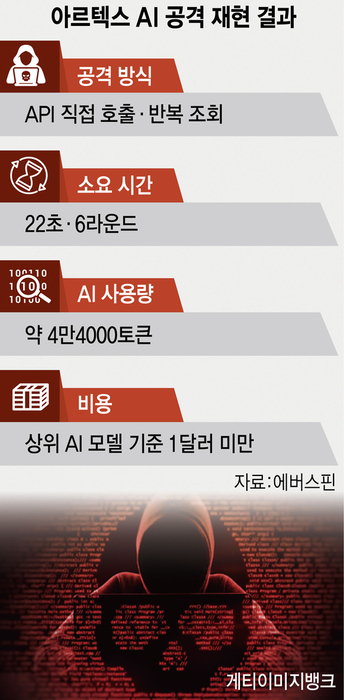
The tokens used in the recreation totaled approximately 44,000, which translates to around $0.88 even when calculating costs based on frontier AI models such as OpenAI's ChatGPT and Anthropic's Claude.
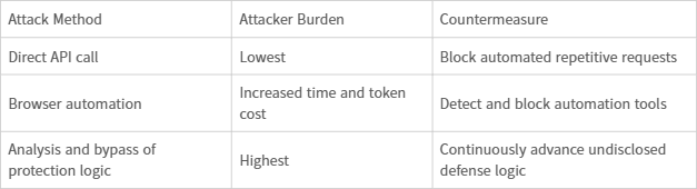
Behind the ability to launch attacks at such a low cost was a structure that could directly call inquiry APIs and repeatedly make requests without going through complex bypass procedures. Through the recreation, Everspin confirmed that ARTEX can directly call inquiry APIs without a browser, automating repeated inquiries and information verification.
The actual speed of attacks in the financial sector was also rapid. At Shinhan Bank, 25,727 pieces of information were leaked in about 30 hours. A simple average works out to approximately one case every 4 seconds. The attacking forces were found to have randomly substituted receipt numbers and repeatedly queried while changing internet protocol (IP) addresses across multiple countries.
There is an urgent need to devise measures in preparation for an increase in low-cost AI cyberattacks.
Everspin presented “increasing attack costs” as the core strategy for responding to low-cost AI attacks. Currently, the financial sector responds by minimizing externally exposed services, eliminating unauthenticated access paths, limiting query counts, and blocking attacking IPs, but attackers can easily bypass these using AI.
As a specific countermeasure, Everspin argues that all “automated requests” that AI can perform must be identified and blocked. Rather than complete blocking, the approach aims to raise the hacker's attack costs to induce the hackers themselves to stop the attack.
For example, if direct calls are blocked, attackers must move to a method of automating actual browsers to make requests. As browser execution and AI judgment are required for each request, time and token usage increase. As costs rise, the burden on hackers grows, making it difficult to launch all-out attacks utilizing AI.
Ha Young-bin, CEO at Everspin, said, “Whenever attackers change their methods, we must force them to spend more time, computing power, and tokens so that mass queries using AI become economically unviable,” adding, “We need to re-examine our response framework in a direction where the more attackers bypass, the more time and cost it takes, without degrading service quality for normal users.”