








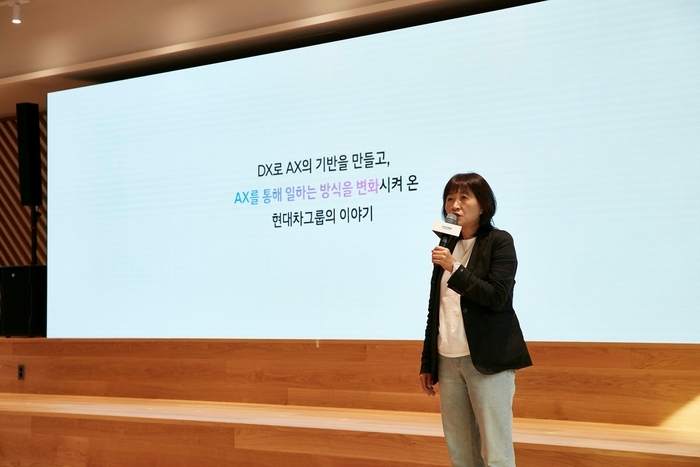
Hyundai Motor Group is expanding its AI transformation (AX) across all business areas, building on its digital transformation (DX) framework initiated in 2019. By leveraging accumulated data assets, the company is innovating work processes and accelerating its leap into the 'Physical AI' era, where AI integrates with physical domains such as vehicles and robotics.
On the 12th, Hyundai Motor Group held the 'AX Achievement Presentation' to share its DX·AX journey, key achievements, and future strategies.
President Jin stated, “AI is merely a tool in the continuum of IT innovation. What matters is how quickly we understand and apply technology in the field to connect individual achievements to organizational success,” adding, “Hyundai Motor Group's goal is not to be the company that uses AI the most, but the one that utilizes it most effectively worldwide.”
The group's AX transformation is underpinned by its advanced DX framework, which has been developed since 2018 when Chairman Chung Eui-sun declared, “We will become a company that is even more IT-like than IT companies.”
Chairman Chung's strong commitment has been pivotal in driving the group's AX transition. It is reported that he proactively embraced AI adoption, even volunteering for Vib Coding education.

Hyundai Motor Group has sequentially introduced global collaboration platforms such as Jira, Duraspace, Confluence, and MS365 to enhance work transparency and collaboration efficiency. Alongside this, the company established a 'Global One Data Pipeline' to standardize and integrate data that had been dispersed across the entire value chain, including research and development (R&D), production, quality, and sales.
Within the integrated data environment, the in-house generative AI platform 'H Chat Pro' has quickly gained traction. As of July, the number of H Chat Pro users surpassed 30,000, accounting for approximately 80% of Hyundai Motor and Kia's general and research staff. Notably, even general employees without specialized coding skills have recently been developing and applying AI agents tailored to their tasks, fostering a culture of AI integration throughout the organization.
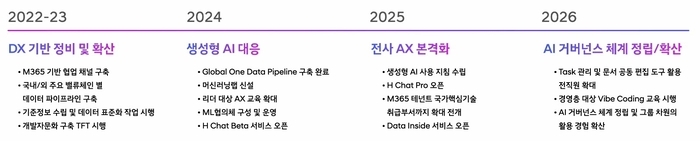
AI integration is driving productivity improvements across all business areas. In R&D, the 'Collision Safety AI Assistant' reduced material review time by 90%, while manufacturing sites achieved annual cost savings of 5.24 billion KRW through vision AI solutions and cut production downtime by 86% via optimized vehicle alignment. Additionally, the manufacturing-specific platform 'E-FOREST: POLARIS' was established to foster on-site R&D environments. In service and customer touchpoints, LLM-based maintenance support reduced response times by 42%, and an automated review response solution slashed per-case processing time from 35 minutes to 5 minutes, enabling AI handling of over 85% of all reviews.
Hyundai Motor Group plans to expand innovation into the 'Physical AI' domain—where AI converges with physical entities such as vehicles, robotics, and smart factories—leveraging accumulated data assets, operational experience, and AI execution capabilities. Furthermore, the group intends to actively support the spread of AI transformation across domestic industries and the creation of an AX ecosystem for SMEs, based on its in-house AX success expertise.
