








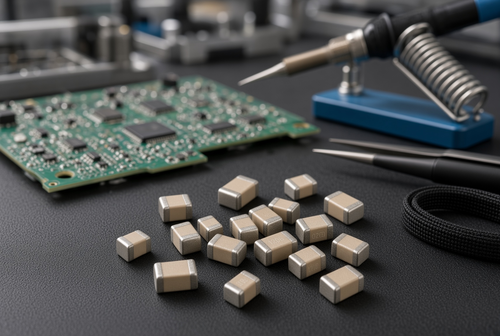
Lead times in the multilayer ceramic capacitor (MLCC) market are diverging sharply by product specification. Standard components remain relatively stable, while lead times for high-capacitance, high-performance MLCCs used in AI servers have stretched significantly.
According to TTI's lead-time trend chart, standard case-size MLCCs were generally running at 14 to 18 weeks—about 3.5 to 4.5 months—as of August. High-capacitance and high-voltage products were typically quoted at 15 to 20 weeks, or roughly four to five months.
Avnet Abacus' August 2026 lead-time guidance similarly listed multilayer surface-mount, high-capacitance and automotive-grade MLCCs at eight to more than 20 weeks, or about two to five months, with its outlook classified as stable.
High-specification products, however, are facing a markedly tighter supply environment. ComponentNews categorized MLCCs for server applications as being in a severe shortage phase, with lead times for Murata and Samsung Electro-Mechanics products exceeding 20 weeks and expected to remain elevated through the second half of the year.
DigiKey lead-time data also show substantial supplier-by-supplier differences in the high-capacitance category. Some Samsung Electro-Mechanics products were reported to have average lead times in the 40-week range. For Murata, lead times for high-capacitance MLCCs of 1 microfarad or more reached as long as 30 weeks in July, up from 24 weeks in June. Some distribution channels have cited lead times of up to 36 weeks.
The main driver of this divergence is surging demand from AI servers and data centers. AI servers require more than five to 13 times as many high-capacitance, compact and highly reliable MLCCs as conventional servers, largely for decoupling and filtering across their power-delivery networks.
Lead times for high-end MLCCs are expected to remain in the five- to 10-month range for the foreseeable future. Unlike previous cycles, when passive-component lead times adjusted more flexibly with broader economic conditions, the current gap is being viewed not as a temporary boom but as a structural reshaping of demand around AI infrastructure.
New capacity additions have been pushed back to the fourth quarter of 2026 or into 2027, making it difficult to resolve the supply-demand imbalance in the short term. Major manufacturers are also raising prices and increasingly entering into long-term supply agreements.
Lead times extending beyond five months and approaching a full year indicate that manufacturers have reached a point where they cannot quickly increase output. They also signal stronger pricing power and an accelerating shift toward improved profitability from higher-value products.
“Because it takes one to two years to build a new production line in the passive-component industry, today's extended lead times are a strong indication that the supply-demand imbalance will be difficult to resolve in the near term,” an industry official said. “For procurement teams, building buffer inventory and considering long-term supply contracts are no longer optional—they are essential.”
