






The landscape of South Korea's imported car market is being reshaped by two leading electrified brands. Tesla has maintained the monthly sales crown for eight consecutive months, nearing 90,000 cumulative units and poised to become the first import brand to surpass 100,000 annual units. Chinese automaker BYD, in its second year in the domestic passenger car market, achieved over 20,000 units in just three quarters.
According to the Korea Import Motor Vehicle Association (KAIDA), September's new registrations for imported passenger vehicles reached 34,904 units—up 17.1% from August (29,817 units) and 6.3% year-on-year (32,834 units in September 2022). Cumulative registrations from January to September 2023 totaled 279,729 units, a 24.1% increase compared to the same period last year (225,348 units).
BYD Korea stood out in brand growth. With 2,614 units registered in September (ranked 4th among import brands), BYD achieved 20,137 cumulative units in Q3, bypassing the '10,000 annual units' mark and directly reaching the 20,000 milestone. This represents a 578.7% surge compared to the same period last year (2,967 units).
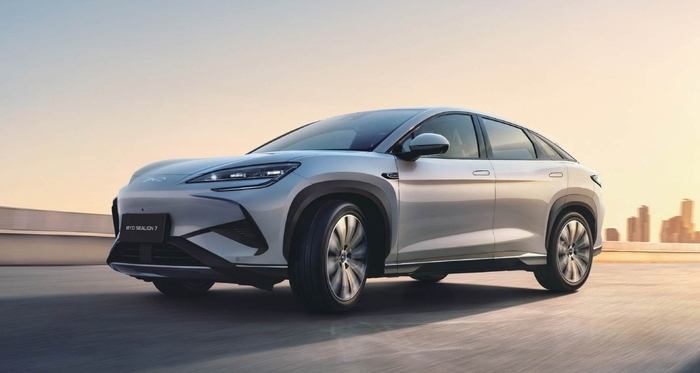
A new brand achieving 20,000 cumulative units in three quarters is unprecedented. Traditional powerhouses like Mercedes-Benz and BMW took nearly a decade to stabilize at 20,000 units, and even Tesla required several years. BYD's affordability-focused models, such as the Dolphin (cumulative 8,198 units), a sub-20 million KRW compact hatchback, and the Seal 7 (cumulative 7,109 units), a mid-sized electric SUV priced around 40 million KRW, have successfully overcome the 'China discount' stigma and the 'EV chasm' with competitive pricing across segments.
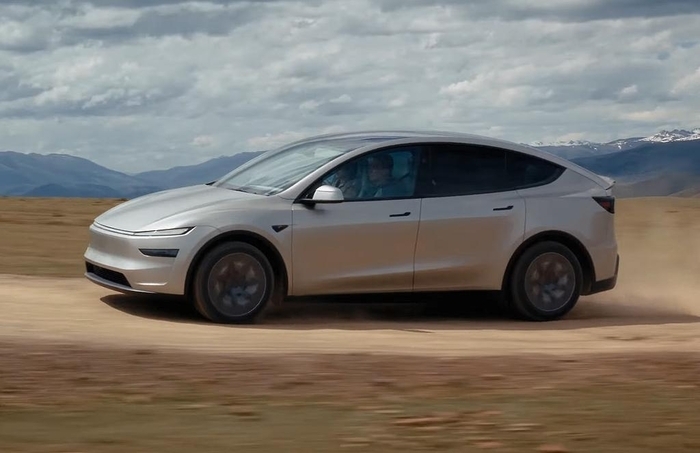
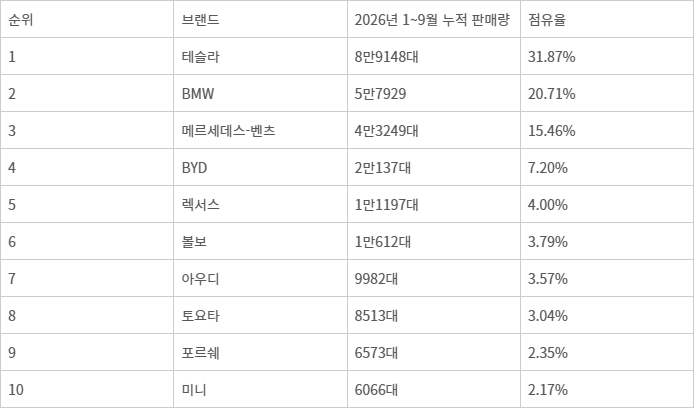
Tesla's dominance has solidified further. The brand delivered 12,372 units in September, extending its monthly sales leadership to eight consecutive months since February. Its Q3 cumulative registrations reached 89,148 units (31.87% market share), a 104.4% jump from the same period last year (43,612 units).
With 10,852 units remaining to hit 100,000 annual units, Tesla is almost certain to become the first import brand to enter the '100,000 annual units' club. The Model Y Long Range (Model Y L) led September with 8,690 registrations, claiming the top-selling trim title, followed by the Model Y Premium (2,467 units).
The traditional German duo maintained 2nd and 3rd places, focusing on internal combustion engine (ICE) and hybrid SUVs/sedans. In September, BMW registered 6,066 units (2nd), and Mercedes-Benz recorded 5,477 units (3rd). Cumulative Q3 figures showed BMW at 57,929 units (20.71% share) and Mercedes-Benz at 43,249 units (15.46%), both trailing far behind Tesla.
The rise of electrified models is transforming the overall market. In September, pure electric vehicles (EVs) accounted for 18,181 units, surpassing 50% monthly share (52.1%). Cumulative EV share through Q3 reached 47.4% (132,582 units). Hybrid vehicles, including mild hybrids, held a 43.1% cumulative share, while ICE vehicles—gasoline (8.9%) and diesel (0.6%)—fell to single-digit percentages.
An industry insider noted, “The hegemony of German premium brands in the import market is rapidly shifting to Tesla, with its overwhelming supply, and BYD, emphasizing cost-effectiveness. Tesla's 100,000-unit milestone and BYD's swift 20,000-unit stabilization reflect a shift in domestic import car consumption toward practical electrified models.”