








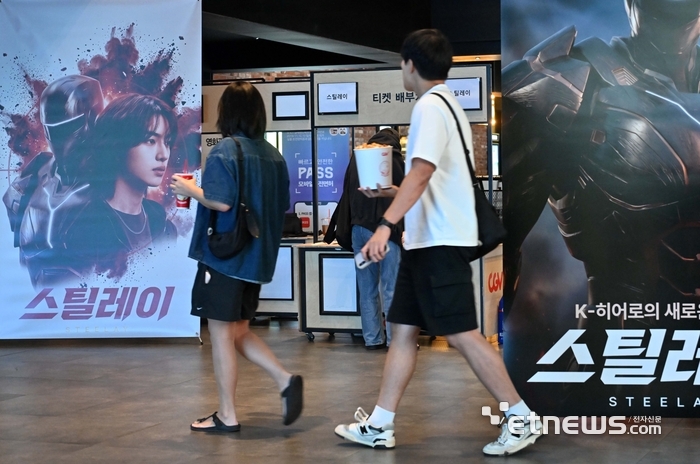
A 90-minute robot sci-fi action film assembled from repeatedly generated 15-second AI video clips is scheduled to open in theaters in October. Still Ray is co-produced by Laon Company Plus and AIKNOW Studio.
AIKNOW Studio used AI tools across the entire filmmaking process, from initial planning and story development to production and post-production, with the project built around a robot sci-fi action premise. As Korean companies have yet to offer commercial AI video-generation services, the production relied on overseas tools including Seedance, Kling, Higgsfield and Google Veo.
Rather than using AI selectively for individual scenes or specific production tasks, Still Ray was completed through what the studio describes as a “full-time AI production” workflow, with AI involved from start to finish.
The film still shows some of the limitations associated with AI-generated video, including occasional unnatural motion and awkward scene transitions. However, the lip movements of its characters generally align with dialogue, while the visuals and voices of the main characters remain consistent across the 90-minute runtime—an indication of how rapidly the technology is progressing.
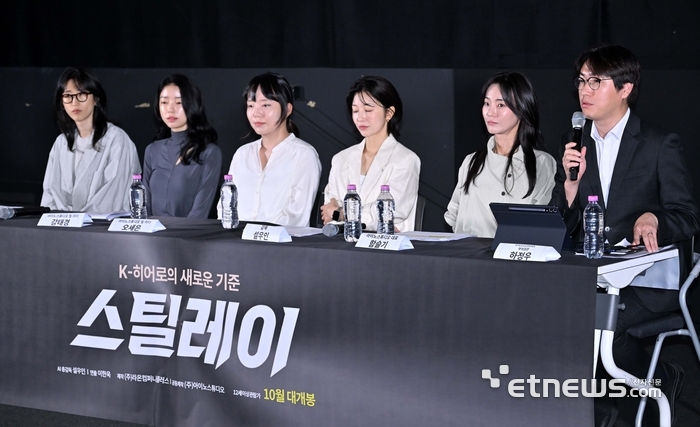
Director Seol Woo-in said at a blind screening held on the 7th at CGV Yongsan in Seoul, “We focused on minimizing the distinctive sense of artificiality often pointed out in AI-generated video, including unnatural movements and facial expressions, and on achieving a level of polish closer to a live-action film.”
The team generated tens of thousands of AI-produced 15-second clips, then selected 13,000 finished segments to assemble the feature-length film. Among Korean companies, AIKNOW Studio oversaw the overall production, while Planby Technologies—provider of Homi AI, an artificial intelligence platform focused on architecture and construction—participated in some image-related work.
According to the producers, Still Ray is Korea's first 90-minute mid-length or feature film made through a fully AI-based production process. The team maintained a consistent visual tone across AI-generated scenes and characters. Rather than using AI-generated voices as-is, it recorded performances by professional voice actors and carried out detailed lip-sync work.
Earlier Korean AI-film projects had taken more limited approaches. CJ ENM's AI-led M Hotel, released in 2024, ran for seven minutes. Middle Realm, a film co-planned by KT last year, used footage filmed with live actors as a foundation, then employed AI to create creatures, crowds, magic, visual effects and fantasy settings. In the five-part anthology Code: G—The Beginning of Attention, only four segments were produced entirely with AI.
AIKNOW Studio said it could have used conventional computer graphics to improve image quality for theater screens, but chose to rely only on AI-based post-production in line with its policy of making the film entirely with AI from beginning to end.
Ham Seul-ki, CEO of AIKNOW Studio, said production began in December last year and was completed in about six months. The total budget is still being finalized but is expected to remain below KRW1 billion. The company spent roughly KRW500 million to KRW600 million on tokens for AI video-generation services alone, meaning AI-service costs accounted for more than half of the film's production budget.
“Making a sci-fi movie normally requires an enormous budget,” Ham said. “We wanted to demonstrate that a film on this scale can be made with AI in Korea, and to show our intention to lead in this field.”
She added that government policy should support not only content production, but also greater opportunities for projects to reach audiences, receive meaningful feedback and pursue future challenges.
Ha Jeong-woo, vice chair of the National AI Strategy Committee, attended the screening. Aside from committee schedules and National Assembly forums, it was effectively his first public engagement in the private sector since taking the post.
“To lead the world as a cultural powerhouse in the AI era, the committee will actively address the areas that require support,” Ha said. “Today, we confirmed the technology's potential. We will work to identify what the industry and professionals on the ground need, and focus on finding ways for Korea to become a global leader in technology-driven media and content, including AI.”
