




OpenAI is strengthening its cybersecurity partnership with South Korea. It is expanding its “Daybreak” partnership, which grants access to artificial intelligence (AI) models specialized in cybersecurity, to private enterprises.
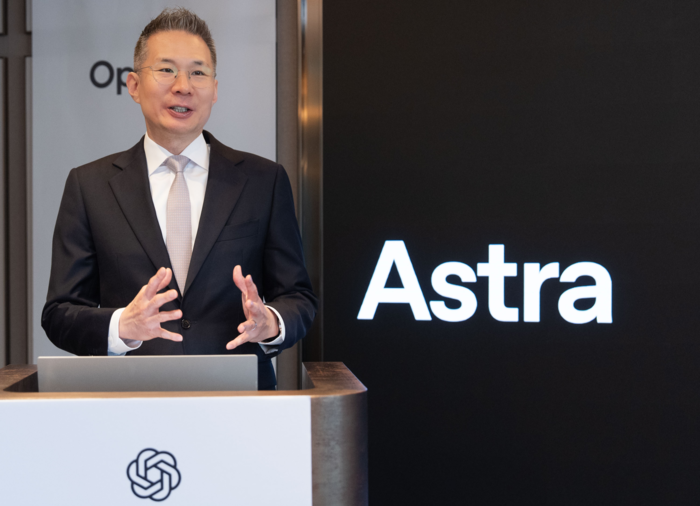
Kim, country manager of OpenAI Korea, said at a press conference celebrating the first anniversary of the launch of the Korea office held at the Josun Palace Hotel in Gangnam-gu, Seoul, on Sept. 9, “We are expanding OpenAI's 'Daybreak' Blue and Red partnerships, which provide access to models such as 'GPT-5.6 Cyber,' from the public sector—such as the government and the Korea Internet & Security Agency (KISA)—to the private sector. We plan to select at least five domestic companies as Daybreak partners to support domestic firms in identifying, verifying, and responding to security vulnerabilities using AI.”
OpenAI is also expanding its domestic partnerships. Along with Samsung SDS, which was selected as the first domestic partner (pilot) for Daybreak, three IT service companies including LG CNS and SK AX, as well as managed IT service companies like MegazoneCloud and Bespin Global, serve as key partners in the enterprise market.
Just as it collaborates with Amazon Web Services (AWS) and Microsoft (MS) in the cloud infrastructure sector in the global market, OpenAI has also left open the possibility of collaboration with domestic cloud service providers (CSPs).
OpenAI evaluated that domestic AI utilization has recently been shifting toward work-oriented usage. In addition to engineers, various departments such as legal, sales, finance, marketing, and operations are utilizing AI, and the role of AI has grown across single workflow processes—from research and analysis to draft creation, software development, and automation.
In fact, the domestic user scale for OpenAI's enterprise service, “ChatGPT Enterprise,” increased 28-fold compared to a year ago. Cases have emerged where entire organizations, such as Samsung Electronics and Seoul National University, adopted OpenAI services. SK, LG Electronics, Kakao, Krafton, GS E&C, TVING, Hanatour, and Nexen Tire have also become major client companies.
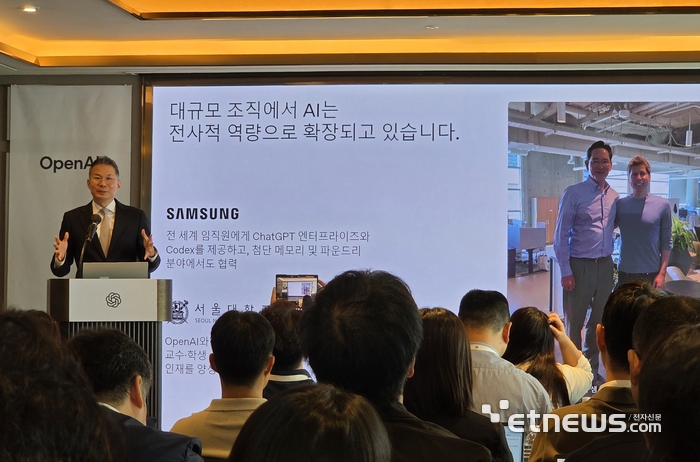
This is interpreted as the result of AI becoming a common work foundation utilized across entire organizations rather than being limited to specific job functions like developers. The number of weekly active users (WAU) for ChatGPT increased by 35% compared to a year ago, and users of ChatGPT Work and Codex surged 14-fold in six months.
“OpenAI Korea will play a role so that the most advanced AI technology can continue to be well utilized in Korea,” Kim said. “We will continue to grow together with Korean users.”
Regarding “GPT-6 Astra,” evaluated as artificial general intelligence (AGI), passing all “Captcha” games (“I am not a robot”) used to prove human identity on the internet on this day, Kim presented the internal policy that the company is continuously strengthening security and guardrails. OpenAI also plans to release a cyber-specialized model utilizing Astra.
“From the perspective that Astra must perform everything a human can do with a computer, it should also be able to solve Captchas,” Kim explained. “We are implementing a safe environment through guardrails as well as monitoring how the model is used and protecting personal data, and Astra can also perform cybersecurity enhancement and cyberattack defense tasks.”
