








Reduction to around 2m units
Virtually a process of exiting the business
Chinese low-cost offensive and market shifts
Restructuring centered on mini LED TVs
Samsung Electronics Co. will cut its quantum dot (QD) TV production by about 80% this year. In the long term, the company plans to phase out QD technology—which has served as a pillar of Samsung's premium TV lineup—from its liquid crystal display (LCD) TVs.
According to industry sources on the 17th, Samsung reduced its QD TV manufacturing volume from about 10 million units last year to a drastically lower level of 2 million to 3 million units this year. Considering that Samsung manufactures about 40 million TVs annually, it has adjusted approximately 20% of its total output.
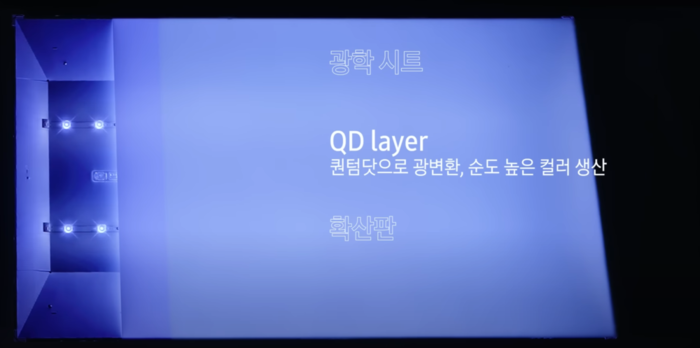
A QD TV is structured by applying a QD film between a blue LED backlight and an LCD panel.
QDs are ultrafine semiconductor materials with sizes under several nanometers (nm, one billionth of a meter). Applying QDs to displays widens the color gamut and enables vivid color reproduction. For this reason, TVs using QD technology are recognized as premium products and are priced higher than conventional TVs.
Last year, Samsung operated its QD TV lineup in two tiers: “QLED,” which uses a standard light-emitting diode (LED) backlight, and “Neo QLED,” which uses a mini LED backlight.
However, starting this year, the company eliminated the QLED lineup, which served as an entry-level segment in its premium tier, and replaced it with “mini LED” TVs that do not incorporate QD. While total TV production remains unchanged, QD TV output has dropped sharply.
The higher-end Neo QLED lineup is also reported to undergo a step-by-step reduction. According to industry sources, a plan to gradually reduce Neo QLED volume through next year and cease manufacturing as early as 2028 is gaining strong momentum. This means Samsung will exclude QD, once considered a premium technology in the LCD TV market, from its lineup.
An industry source familiar with the matter said, “Samsung's QD TV shipment plan for this year has been significantly reduced to less than 30% of previous levels,” adding, “For Neo QLED, the plan is to produce only half of this year's volume next year and gradually stop manufacturing.”
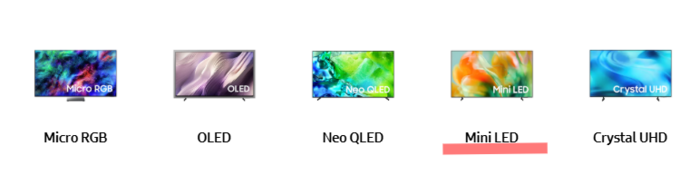
Samsung's strategy is to reorganize its portfolio around mini LED TVs with superior contrast ratios, rather than QD TVs, which excel in color representation.
Fierce price competition from Chinese manufacturers and changing market environments are cited as decisive factors in Samsung's shift in strategy. Chinese makers have flooded the market with low-cost QD TVs, using minimal amounts of QD material or even omitting it entirely, leading Samsung to conclude that competing head-on offers no practical benefit.
In South Korea, Hansol Chemical Co., a QD supplier for Samsung, filed a complaint against TCL with the Fair Trade Commission (FTC) in 2024 over “fake QD.” A series of false advertising lawsuits regarding QD TVs were also filed against Chinese TV makers such as TCL and Hisense in courts across Germany, Australia, and the U.S.
Although a German court recently ruled this year that TCL engaged in false advertising for its QD TVs, Samsung appears to have ultimately decided to secure competitiveness by streamlining its lineup.
An industry source said, “Samsung has stepped away from QD TV competition with China,” adding, “Going forward, it will compete in premium TVs with mini LEDs, and in higher tiers with red, green, and blue (RGB) mini LED TV product lines to be launched in the future.”
