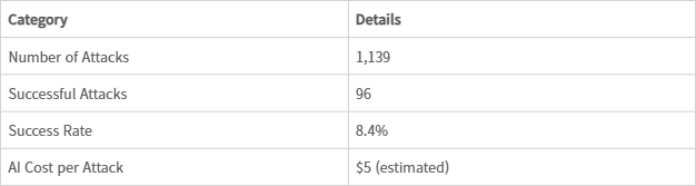



Cyberattacks using artificial intelligence (AI) agents have been found to achieve a success rate of approximately 10% at an average usage cost of $5 per attack. The findings, based on a retrospective analysis of actual attacks rather than simulated penetration tests, show that low-cost, large-scale hacking using AI has become a reality.
U.S. cybersecurity company Norforge released the findings on Oct. 19 (local time) after tracking and analyzing more than 20 administrative panels of Cairn, an AI-powered attack tool used by hackers.
Based on attack records, Norforge confirmed that three hacking groups carried out a total of 1,269 attack projects. Of these, 134 projects (10.6%) reported tangible attack results. AI token usage costs were estimated at an average of approximately $5 per project.
The most active group, consisting of Chinese-speaking attackers, conducted 1,139 attack projects, accounting for 89.8% of all attacks. The group targeted e-commerce websites in major countries, including the United States, Canada, Japan and Australia. Of those attacks, 96 (8.4%) produced tangible results, such as server intrusions or access to information. Agricultural equipment manufacturer Deere, home appliance company SharkNinja and engine manufacturer Cummins were reportedly among the targets.
Cairn, the tool used by the hackers, is an open-source platform that allows multiple AI agents to collaborate on assigned objectives. Its architecture enables multiple AI agents to share collected information, accumulate task results and apply those results to subsequent stages. The attacks reportedly used an environment combining Anthropic's Claude Code and China's DeepSeek.
The attack instructions were brief, consisting of fewer than 100 Chinese characters. The hackers issued commands to the AI such as “Find a vulnerability that allows commands to be executed on the server without logging in,” “Prioritize database attacks or authentication bypass attempts,” and “If the intrusion succeeds, install a program for uploading files.”
The AI agents carried out attacks for extended periods without additional detailed instructions. When an attempt failed, they searched for alternative intrusion paths, and some attack projects continued for more than five days. Projects that achieved their intrusion objectives took less than 23 hours on average.
Another notable finding was that the AI hacking operations left extensive traces of the attacks. Norforge explained that the administrative panels of Cairn used by the hackers were exposed to the internet without security protections, allowing them to be detected by search services such as Shodan and Censys. This is believed to reflect a failure to follow basic security practices, unlike highly skilled hackers.
“This study shows how AI agents infiltrate real-world systems,” Norforge said, emphasizing that analyses of AI attack methods should be incorporated into efforts to strengthen future cybersecurity defenses.