




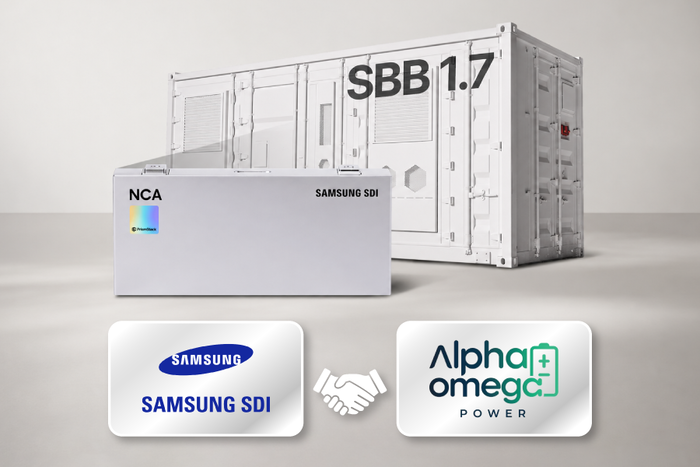
Samsung SDI said on Monday that its U.S. subsidiary, Samsung SDI America (SDIA), has signed a contract with American energy company Alpha Omega Power (AOP). Under the deal, SDIA will supply 1 gigawatt-hour (GWh) of energy storage system (ESS) solutions.
Including the first order signed late last year, the total comes to 1.5 GWh. AOP plans to deploy the systems in a large-scale power project in Texas, where construction is set to begin next year.
The product covered by the new contract is the SBB 1.7, an all-in-one ESS solution built around nickel-cobalt-aluminum (NCA) batteries. It will be manufactured at the Star Plus Energy (SPE) plant in Indiana and delivered within this year.
The SBB 1.7 uses high-capacity, high-nickel NCA cathode material. It keeps the same 20-foot container size as the earlier SBB 1.5 but offers 17% higher energy density. It also incorporates AI-based algorithms for early fault detection and lifespan prediction, bringing together Samsung SDI's accumulated expertise in ESS design.
The system has also earned NFPA 855, the National Fire Protection Association's fire-safety standard for stationary energy storage installations, and UL 9540, a safety certification for ESS. It also uses Samsung SDI's proprietary EDI (in-module direct injection) technology for added fire safety.
“Samsung SDI's U.S.-made ESS will play an important role in our continued growth,” said Paul Choi, CEO of AOP. “This agreement will also help strengthen the domestic supply chain that supports next-generation energy infrastructure.”
“AOP is one of the fastest-growing independent power producers in the United States,” said Fabrice Hudry, executive vice president and head of the ESS team at SDIA. “With our differentiated technology and local production, we will continue to expand our business base and strengthen our position in the North American ESS market.”
