




CHINGMU, a physical AI technology company that works with leading Chinese robot makers such as Unitree and AgiBot, is entering the Korean market with a solution for collecting robot training data.
According to industry sources on Nov. 8, Shanghai-based CHINGMU recently appointed Director Yang Ziyi as head of its Korean branch and began expanding its business in Korea.
Founded in 2015, CHINGMU specializes in optical motion capture. It is extending technology built up in film, gaming, and animation to humanoid robot motion learning, teleoperation, and performance validation.
Its core technology uses optical cameras and sensors to convert the movements of people and objects into robot training data. A person wears a suit fitted with markers and moves around, while cameras track each marker's position and trajectory and quantify joint angles and motion. The data then goes through “retargeting,” a process that maps the captured motion onto a robot's own joint structure, before it is used for training. CHINGMU has been testing the technology on products from major Chinese robot makers, including Unitree and AgiBot.
The company recently unveiled OptiUMI, a portable data collection device developed with China's Dexrobot. The user holds a gripper-style device in each hand and picks up or moves objects, while cameras and sensors record the motion and convert it into robot training data. Unlike existing devices, OptiUMI adds optical motion capture, so it can also track an object's path and its spatial relationship to surrounding objects. CHINGMU aims to launch it in China and Korea at the same time around the end of this year.
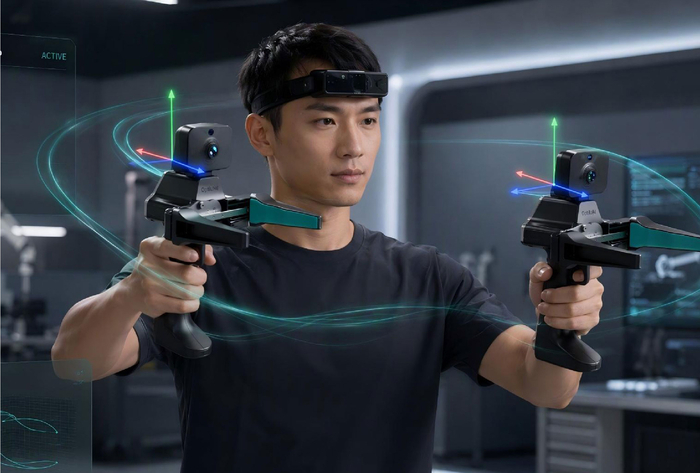
Its key feature is that people can generate data by doing the task themselves, with no robot body and no expensive separate teleoperation rig. It is pitched as a way to cut the cost of conventional methods, which require large fleets of robots and many operators.
CHINGMU's move shows Chinese robot companies expanding overseas beyond selling finished robots to providing the infrastructure for collecting physical AI training data. Korean robot makers and AI developers also gain a new option alongside robot-based data collection.
“Robot learning requires data on physical interaction with the surrounding environment,” Yang said. “As technologies that collect data without a robot body gain traction in Korea, we expect the physical AI market to grow.”
