




South Korea's Personal Information Protection Commission (PIPC) has urged smart glasses users to notify people nearby when taking photos or recording video or audio, and to stop if someone objects. The commission also plans to issue privacy guidelines by the end of the year outlining responsibilities for users, manufacturers, and service providers.
On Nov. 9, the PIPC released a report analyzing the key features and privacy risks of smart glasses, along with precautions for their use. The move follows growing concerns about the devices, including their potential use for cheating on college entrance exams and invading privacy.
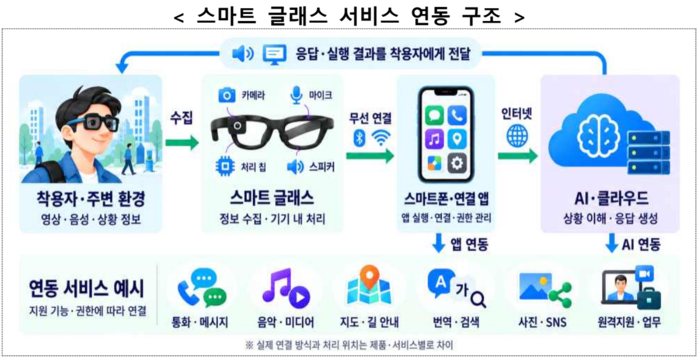
Smart glasses are wearable devices that process images and audio collected through cameras, microphones, and sensors by connecting to smartphones, AI systems, and cloud services. Because they resemble ordinary glasses and require no obvious recording gesture, people nearby may struggle to tell whether they are being photographed or recorded. Even when a recording indicator is present, it may be difficult to notice or could be covered by the user. Some models can also record when they are not being worn.
The flow of personal data can also be complex. Collected information may pass through multiple devices and companies, while manufacturers may use third-party AI models and connected services may operate under different privacy policies. People around the wearer, rather than the wearer themselves, are particularly likely to be captured. Privacy risks can increase if their images or voices are used to train AI or shared on social media.
The PIPC recommended that users review what personal data each device and app collects, how it is used and processed, and the consent requested during initial setup and before using services. It also advised users to keep managing their privacy settings, including disabling unnecessary features.
The commission urged users to refrain from using smart glasses—or, where possible, avoid wearing them—in places where photography and recording are prohibited, such as restrooms and changing rooms, or restricted, such as courtrooms and exam venues. It added that unauthorized filming and recording private conversations between other people may be subject to applicable laws.
When taking close-up photos or videos, or in situations where conversations could be recorded, users should make people nearby aware that recording is taking place and stop if someone objects, the commission emphasized.
Businesses should clearly explain why they collect and use personal data and how it moves through their systems. If they intend to use collected information for AI training, they must meet the legal requirements for processing it, such as obtaining consent in advance. The PIPC also urged manufacturers to build privacy into device design so that people nearby can easily tell when photography or recording is taking place.
The commission plans to conduct further analysis and gather feedback before issuing the guidelines by year-end. It will also work with relevant ministries, including the Ministry of Science and ICT, to strengthen the privacy framework in response to emerging technologies such as wearable devices and physical AI.
