






The global semiconductor race is expanding beyond individual chips to encompass the entire AI infrastructure stack, according to a new industry analysis.
The Korea-US AI Semiconductor Innovation Center (K-ASIC) made this assessment in its “First Half 2026 US Semiconductor Industry Trends” report, noting that the center of competition in the semiconductor industry has shifted from individual chip performance to AI infrastructure as a whole.
K-ASIC is a hub for Korean system semiconductor companies, established in San Jose, California in September 2024 under the leadership of Korea's Ministry of Trade, Industry and Energy. It supports Korean fabless, IP, and design firms in entering the US and other global markets, offering services including technology development and validation, certification consulting, network building, and market analysis. The latest report draws attention for analyzing the current state of the global AI semiconductor industry, including the US market, and offering a forecast for the second half of the year.
Based on its analysis of the first half of the year, K-ASIC said fabless companies like Nvidia, AMD, and Broadcom have moved beyond competing on GPUs and application-specific integrated circuits (ASICs) alone, now competing on integrated system platforms instead. Meanwhile, hyperscalers such as Google, Amazon, Meta, and Microsoft are building vertically integrated AI platforms that bring together their own chips, data centers, and power assets.
In other words, the race is no longer just about how fast or how much computation an AI chip can handle. It has broadened into a competition to secure the entire AI infrastructure stack, including memory, power, networking, and data centers.
K-ASIC identified three key bottlenecks standing in the way of AI infrastructure buildout: power, which determines the limits of AI data center expansion; optical communication, needed to connect tens of thousands of AI accelerator chips; and quantum computing, which is emerging as the next computing paradigm.
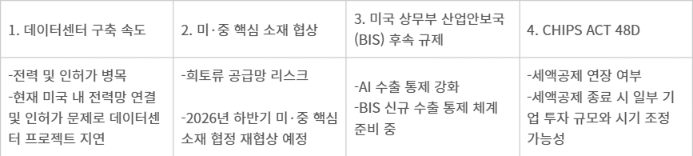
On power, K-ASIC said that starting in the second half of the year, the pace of AI data center construction will increasingly be determined by access to power rather than access to chips. The report noted that the real constraint isn't power generation capacity itself, but the speed of grid interconnection. In the medium term, hyperscalers are moving to secure their own power generation assets directly, while longer term, they are pursuing nuclear power as a strategic energy source.
As for optical communication, K-ASIC said traditional copper-based electrical connections are approaching their physical limits in AI chips and data centers, in terms of bandwidth, power consumption, and heat generation. The report pointed to silicon photonics-based optical communication as the emerging solution, noting that by using light instead of electrical signals to transmit data, optical communication offers higher bandwidth, lower power consumption, and longer transmission distances, making it a strong candidate to solve multiple AI data center challenges at once.
While power and optical communication are seen as solutions to current AI infrastructure bottlenecks, K-ASIC forecasts that quantum computing will mark the starting point of a new race for leadership in the next generation of computing, beyond AI.