








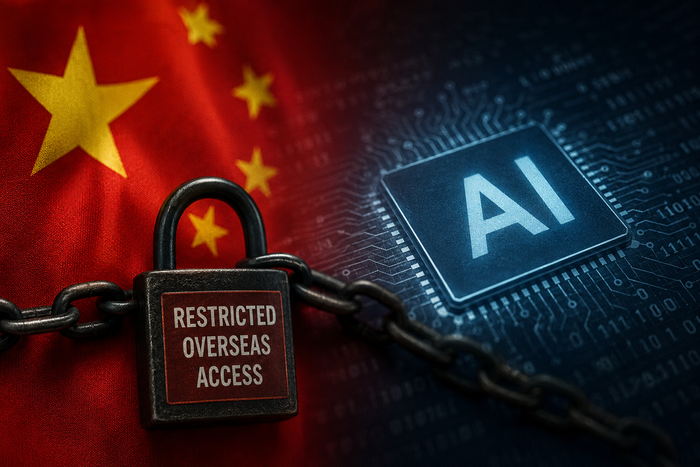
The Chinese authorities are reportedly considering a plan to restrict overseas access to their domestic state-of-the-art artificial intelligence (AI) models.
According to a report by Reuters on the 7th (local time) citing multiple sources, China's Ministry of Commerce held a closed-door meeting last month with representatives from companies such as Alibaba, ByteDance, and the startup Zhipu AI, as well as officials from the National Development and Reform Commission, an economic planning agency, to share this information.
Sources said that the meeting discussed ways to restrict the overseas export of cutting-edge AI models, including not only closed-source models but also open-weight models that disclose their weights externally.
Along with this, it was reported that they also discussed measures to punish the leakage or theft of core AI technology as violations of the National Security Law, and the possibility of introducing regulations to restrict investment eligibility for Chinese AI startups.
All three companies that attended the meeting that day possess various AI models, some of which are provided in a closed-source manner and others in an open-weight format.
Alibaba's 'Qwen' and ByteDance's 'Doubao' are considered the most commonly utilized AI models in China. The 'GLM-5.2' model, unveiled by Zhipu AI this year, also drew attention for delivering performance comparable to advanced US models at a low cost.
This move by China is interpreted as showing that the Chinese government, like the United States, has begun to regard state-of-the-art AI as a core national strategic asset.
It is also a move that comes amid the US recently introducing measures to block foreign nationals' access to Anthropic's top-tier AI models for national security reasons.
If the Chinese government restricts the overseas provision of its domestic AI models, it is projected to have a significant impact on the global AI market as well. This is because costs are highly likely to rise for companies that have been utilizing inexpensive Chinese AI models.
Currently, it is not known in what manner the Chinese government will restrict overseas access to its AI models, nor is the specific scope of the regulations.
However, Reuters reported that the direction can be guessed by looking at what the Supreme People's Court of China discussed regarding open-source AI regulations last May.
At that time, meeting attendees proposed applying phased standards: requiring a simple registration process for basic open-source tools, national security reviews for more advanced technologies, and either not disclosing them to the public or allowing them to be used only within China for the most sensitive frontier models.
China has been implementing a series of measures to protect its domestic AI industry since this year.
Last April, the National Development and Reform Commission requested Meta to withdraw its acquisition of Manus, a Chinese AI startup. In early June, it announced new rules to more strictly manage foreign transactions involving Chinese investors, technology, data, and national security.
