








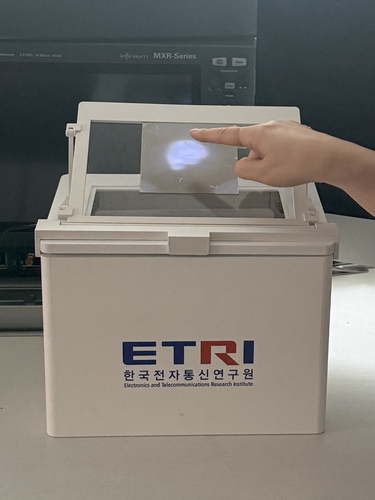
A South Korean research team has successfully developed a non-contact interface technology that allows users to manipulate screens hovering in mid-air. This achievement marks the domestic production of core components for 'aerial holograms,' which were previously monopolized by Japan. It is expected to pave the way for a touch-free environment free from infection concerns.
The Electronics and Telecommunications Research Institute (ETRI) announced on the 21st that it has localized the production of mirror-reflective sheet (hologram sheet) technology and developed core components for 'pseudo-hologram (hovering hologram)' technology, enabling direct finger manipulation of images displayed in the air using domestic original technology.
Pseudo-hologram technology reproduces light emitted from a display onto a special mirror-reflective sheet, creating the illusion of an image floating in mid-air without the need for separate glasses or screens. When combined with spatial touch sensors, users can directly interact with the floating screen using their fingers. It is gaining attention as a next-generation non-contact interface technology.
The mirror-reflective sheet, a core component of pseudo-holograms, has been exclusively supplied to the global market by Japanese companies based on precision microfabrication technology. To address this, the research team developed an independent process using polymer materials, photolithography, and imprinting technology to produce high-resolution mirror-reflective sheets.
Based on this, the team fabricated a 10×10 cm mirror-reflective sheet and created a prototype that projects holographic images into the air. The developed technology can be applied to various non-contact user interface fields, including surgical site tracking monitors, glasses-free medical displays, public facility touch-free guidance systems, elevator buttons, and smart massage chair control devices.
In particular, with the growing demand to minimize contact with shared touchscreens following the spread of infectious diseases like COVID-19, its potential for use in medical institutions and high-traffic facilities is expected to be significant.
Kim Joo-yeon, a principal researcher at ETRI, stated, “We plan to enhance the integration of spatial touch sensors to advance the technology to a level where users can freely manipulate mid-air images.”
The research team plans to further develop spatial touch functionality, conduct demonstrations in domestic public institutions and high-traffic facilities, and explore entry into global markets through exhibitions in the Middle East, the United States, and other regions.
