




U.S. curbs and shortages drive local tool adoption
Domestic share rises in etching and deposition
S. Korean exporters face shrinking market
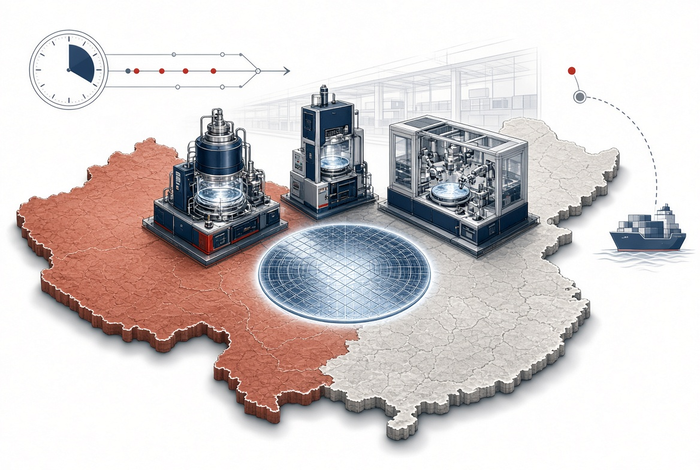
The proportion of domestic semiconductor equipment installed in Chinese wafer fabrication plants (fabs) has grown rapidly to one out of every three units. Analysts say that while U.S. export restrictions have accelerated localization, recent global equipment shortages have also driven more Chinese companies to seek domestic alternatives.
On Sept. 14, Chinese semiconductor market research firm Jiwei(JW Insights) reported that Chinese-made semiconductor equipment accounted for approximately 23% of market sales and 35% of total installed units.
The sales-based metric represents the share of domestic equipment in the total spending by Chinese companies on new tools that year. Installed base measures equipment already set up inside fabs. While a larger portion of purchasing budgets still goes to overseas equipment, one in three machines physically running in Chinese fabs is now locally produced.
These figures reflect data compiled for 2025, and the proportion of domestic tools is estimated to have increased further in the first half of this year.
High-value equipment, such as extreme ultraviolet (EUV) lithography systems, remains subject to low domestic market shares due to high barriers to entry, even as U.S. export controls bite. However, the market share for etching, deposition, and peripheral process equipment has continued to rise. This suggests that fabs are being filled with locally produced equipment starting from tools with lower development difficulty.
China's 35% installed base share represents a 10 percentage point increase from 25% in the previous year. This far surpasses South Korea, where the domestic equipment share in installed units remains around 20%.
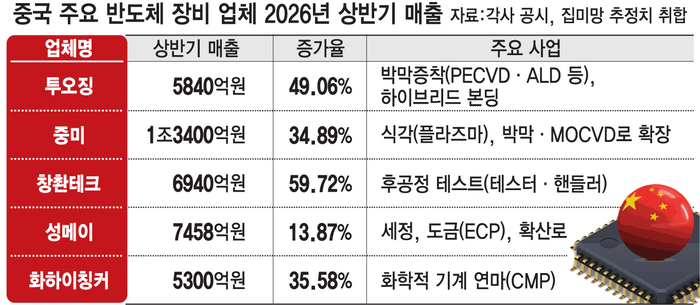
Driven by expanding domestic supply, most of China's top eight semiconductor equipment makers posted double-digit revenue growth ranging from 13.8% to 69% year-on-year in the first half of this year. Companies specializing in etching, deposition, and cleaning equipment achieved particularly visible numeric growth.
The surge in domestic equipment adoption in China was also influenced by longer lead times for global equipment. Lead times for key equipment from the world's top five suppliers—Applied Materials, ASML, Lam Research, Tokyo Electron, and KLA—have recently expanded to 1.5 to 2 times their previous length. Lead times for etching and thin-film deposition extended from 6 months to 12 months, while advanced packaging and testing tools now take over 18 months. Imported radio frequency (RF) power supplies take up to 24 months. Furthermore, securing equipment has become harder for Chinese firms as major global toolmakers prioritize advanced node orders for Taiwan Semiconductor Manufacturing Company (TSMC), Samsung Electronics, and SK Hynix.
In contrast, Chinese suppliers offer relatively shorter lead times. Etching equipment from Advanced Micro-Fabrication Equipment Inc. (AMEC) takes about 9 months, and chemical vapor deposition (CVD) equipment from Piotech takes around 10 months. The adoption of domestic equipment is also rising in peripheral systems such as temperature and humidity control modules and Equipment Front End Modules (EFEMs). Key vendors including AMEC, Piotech, Naura Technology Group, and ACM Research are expanding local order volumes in China, with AMEC broadening its portfolio from mature nodes into advanced etching equipment.
Analysis suggests that as China satisfies its domestic demand with local equipment, new orders for mid-sized South Korean equipment makers that rely heavily on exports to China are declining.
Jusung Engineering, which relies heavily on Chinese exports, generated about 85% (346.4 billion KRW) of its 409.4 billion KRW revenue from China in 2024. However, its revenue dropped 24% to 310.7 billion KRW in 2025, while its order backlog shrank from 303.6 billion KRW at the end of 2022 to 97.8 billion KRW at the end of 2025. Nextin, which also derived around 85% of its sales from China in 2024, saw its 2025 revenue drop 41% from 113.7 billion KRW to 67.0 billion KRW, shifting to an operating loss. Industry insiders view the buy-local preference among Chinese fabs as narrowing sales channels for South Korean equipment makers.
“As Chinese fabs are now able to choose domestic equipment rather than wait for global tools, South Korea's mid-sized equipment makers are facing a negative impact on their China business,” an industry official said. “Rather than competing on price and delivery times in mature etching and deposition equipment, Korean firms must shift focus to advanced processes, high bandwidth memory (HBM), inspection equipment, and bottleneck modules like vacuum and metrology systems, while expanding entries into non-Chinese mass production lines.”
