







Hit by Collateral Damage from FCC Regulations Targeting China
Sanctions on Humanoids and Autonomous Mobile Robots
Manufactured in US... Export Conditions Complex
SMEs Anxious... Urgent Need for Extraordinary Measures
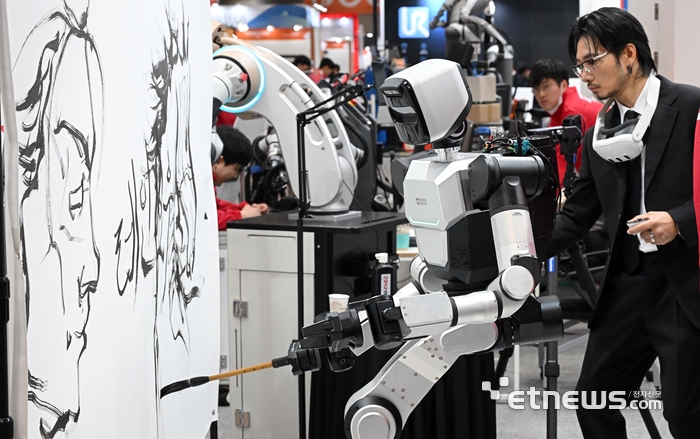
Korean companies are in a state of emergency as the US Federal Communications Commission (FCC) regulates imports of foreign humanoid robots and autonomous mobile robots (AMRs). Following the FCC measures, export routes to the United States have been completely blocked for some robot companies. Pointed out is that government-level measures are urgent.
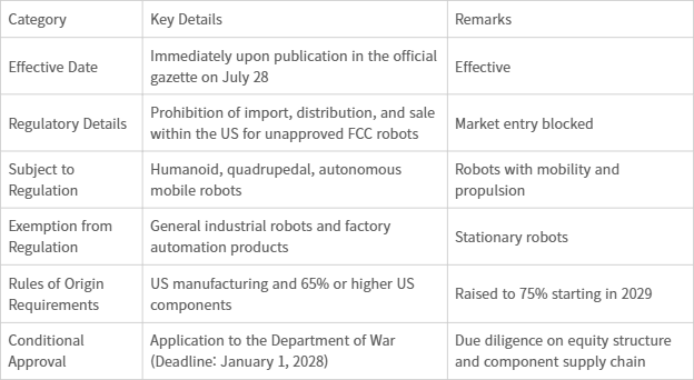
The origin is the import regulation measures on foreign robots announced by the FCC in July. The FCC has been imposing sanctions so that advanced robots without new approvals cannot be imported, distributed, or sold in the US starting July 28. Robots with propulsion and tele-operability, such as humanoid robots, quadrupedal robots, AMRs, and automated guided vehicles (AGVs), are subject to regulation. Although known to be regulations targeting China, all foreign robots regardless of nationality are subject to them.
Immediately, Rainbow Robotics, a subsidiary of Samsung Electronics that exports the mobile humanoid robot 'RB-Y1' to the US, saw its exports to the US halted following the FCC regulation. Export contracts for dozens of units with major North American clients have come to a standstill. Unclear is whether exports to the US can be resumed in the future.
Domestic AMR Company A succeeded in securing its first order in the US, but is suffering due to the FCC regulation. It inquired about response measures with the Ministry of Trade, Industry and Energy (MOTIE), the Korea AI & Robot Industry Association, and the Korea Trade-Investment Promotion Agency (KOTRA), but failed to receive a clear answer. On the verge of being lost is the hard-won opportunity to export robots to the US.
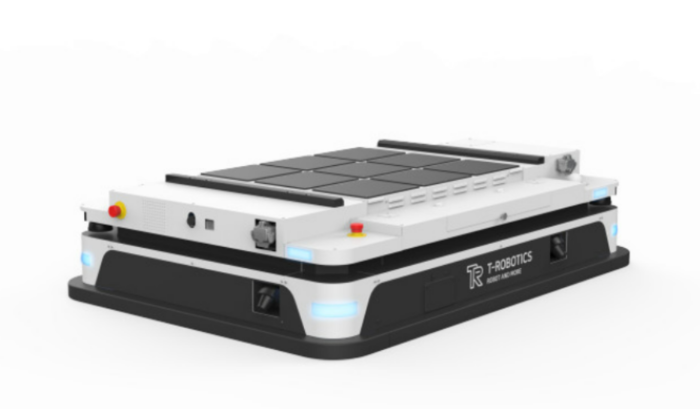
T-Robotics is also within the impact zone. T-Robotics signed a supply contract worth about KRW15 billion for AGVs with Ford Energy Battery in June. Because the supply region is the US and the contract period runs until June 2028, a review of export regulation impacts is required. T-Robotics is preparing response measures centered around its legal team.
To be excluded from FCC regulations, humanoid robots and others must be manufactured in the US, and the US proportion in the component supply chain must be 65% or higher. From 2029, 75% or higher must be met.
However, establishing US manufacturing facilities requires significant time and massive investment costs. Procurement of core robot components such as motors, sensors, and reducers within the US itself is also difficult, making regulatory evasion virtually impossible according to the prevailing consensus. Global robot companies procure core components from Korea, Japan, China, Germany, and other regions.
To export advanced robots to the US, submitting a conditional approval application to the US Department of War by January 1, 2028, and obtaining permission is the only solution. However, given that the procedure is picky and complex, individual corporate-level responses have limits. In particular, domestic small and medium-sized robot enterprises lacking manpower and capital are in a situation where formulating measures itself is impossible.
Accordingly, pointed out is that the government must devise extraordinary measures. MOTIE and related organizations should present company support plans and communicate with the US executive branch for regulation exemptions.
An official from a domestic company exporting robots to the US said, “For an individual company to prepare equity structure and supply chain data to deal with the US executive branch, the burden is great,” adding, “A government-level support channel for the certification and screening process must be established.”