



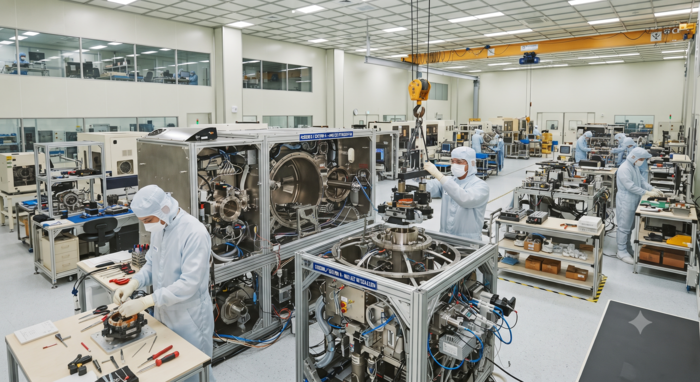
Delivery lead times for essential components used in semiconductor equipment have doubled, plunging the equipment industry into a supply shortage.
While demand for semiconductors and manufacturing facilities has surged due to the spread of artificial intelligence (AI), the component supply chain is failing to meet demand owing to limited production capacity. Concerns are growing that this will become a factor dragging down the investment sentiment across the overall semiconductor industry.
According to the industry on the 16th, the delivery period (lead time) for essential components used in semiconductor manufacturing equipment has more than doubled. A senior executive at domestic Equipment Company A, which manufactures deposition equipment, said, “We are experiencing difficulties in component procurement,” adding, “We used to receive components for deposition equipment within four months after ordering, but recently that has increased up to 10 months.”
Company B, which manufactures semiconductor laser process equipment, is reported to take up to 40 months to receive core Japanese-made components. A Company B official said, “We want to receive deliveries quickly even if we pay a premium, but we received notice that it is difficult to bring forward the lead time because component suppliers' production capacity (capa) is limited,” adding, “Without securing an alternative supply chain, manufacturing equipment immediately is a difficult situation.”
Packaging equipment company C built a component supply chain in South Korea, but its deliveries are also being delayed. A Company C executive said, “The situation is better than procuring from overseas, but still, taking components takes about 50% more time than usual.” This means that components for manufacturing packaging equipment, which were usually received within four months, are now delivered only after six months or more.
The biggest factor in the component supply shortage is the surge in demand. This is because the number of AI semiconductors and memories has increased sharply due to the spread of AI and the rapid rise in infrastructure investment. Equipment is needed to manufacture semiconductors, and core components such as modules are essential to build equipment.
The prevailing view is that component manufacturers failing to prepare for the 'AI boom' and not expanding production capacity in advance caused the supply shortage.
An industry official said, “Even if the component industry expands production capacity now, it is too late to respond to current demand,” adding, “On top of this, because it is uncertain when the semiconductor supercycle driven by AI will turn down, even investments in expanding production are not proactive.” In particular, the Japanese component industry, which is a main pillar of semiconductor equipment manufacturing, is known to be conservative regarding production capacity investment.
The industry atmosphere of avoiding Chinese components is also contributing. This is due to the U.S.-China trade conflict. If Chinese parts enter the supply chain of core components for making cutting-edge semiconductors, the possibility of transaction restrictions with U.S. semiconductor manufacturers is also raised. Excluding Chinese parts, which grew rapidly in the semiconductor equipment component market through price competitiveness, makes finding alternatives not easy.
Concerns are also raised that component supply shortages will exacerbate delays in semiconductor equipment deliveries. It is reported that the period for semiconductor manufacturers to receive equipment deliveries has also doubled compared to normal times. In particular, it is understood that deliveries take longer for global semiconductor manufacturers where facility investment is in full swing.
A semiconductor equipment industry official predicted, “As component supply shortages for equipment are added on top of semiconductor equipment delivery delays, the possibility that global semiconductor production infrastructure investment will be delayed has increased,” adding, “Samsung Electronics Co., Ltd. and SK Hynix Inc., which are currently promoting investments in Pyeongtaek and Yongin, will also be affected.”
