








“No major abnormalities in the retina, but the risk of cardiovascular disease is high. Let's re-examine in four months.”
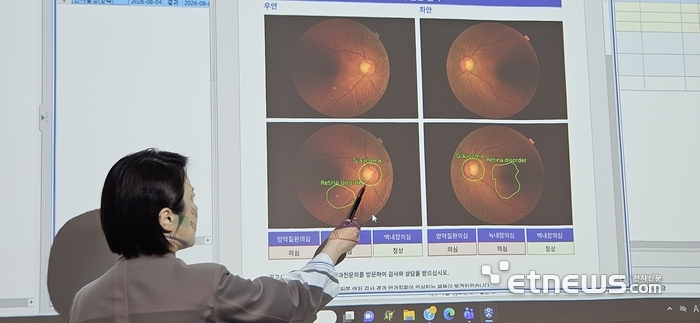
On the 4th, at the Diabetes Center of the Endocrinology Department at Seoul Severance Hospital, a man in his early 50s, Mr. A, sat in front of the fundus camera. The imaging was completed in one minute. The artificial intelligence (AI) immediately analyzed the retinal images. The results showed suspected mild retinal disease and a coronary artery calcification index classified as “high-risk.” This was an unexpected outcome for Mr. A, who had been taking medication for hyperlipidemia.
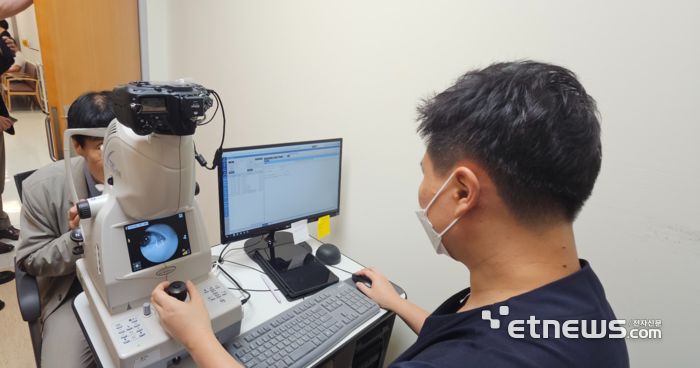
The Diabetes Center at Severance Hospital combines MediWhale's AI solution with fundus photography to assess cardiovascular disease risk. By analyzing subtle changes in retinal blood vessels, the system predicts the likelihood of coronary artery calcification.
Ms. B, a woman in her late 50s who underwent the examination that day, received a suspected diagnosis of glaucoma and retinal disease. Her coronary artery calcification index was classified as “moderate risk.” The medical team recommended additional blood tests to detect thyroid disease and prediabetes early.
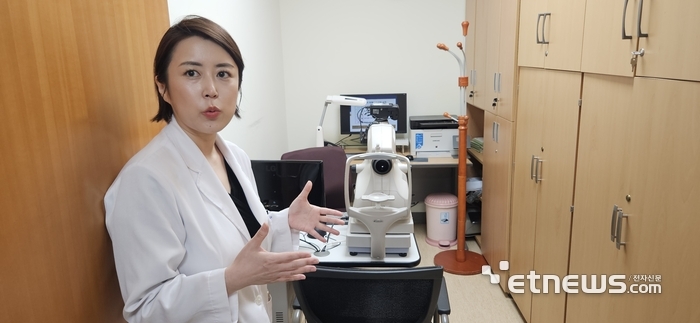
Professor Kim Hye-kyung of the Endocrinology Department at Severance Hospital, who oversaw the treatment, stated, “Disease prediction AI based on retinal imaging shows high accuracy comparable to cardiovascular computed tomography (CT).” She added, “We perform an average of 200-300, and up to 500, AI-based fundus examinations daily.” Professor Kim further explained, “The preparation is simple, the imaging time is only 1-3 minutes, and results are available immediately after the test, making patient acceptance significantly higher than with CT scans.”
The government has begun efforts to expand the use of advanced medical AI, which has proven its potential in medical institutions, to actual clinical settings.
The Ministry of Health and Welfare and the Korea Health Industry Development Institute held a kick-off meeting and signing ceremony for the “AI Application Product Rapid Commercialization Support Project (AX-Sprint)” at Severance Hospital. This initiative will provide full support for the clinical application and early commercialization of medical AI products.
Previously, even if excellent AI medical devices were developed and approved by the Ministry of Food and Drug Safety, there were many barriers to their adoption in actual medical institutions and inclusion in health insurance reimbursement. Even after technology development and approval, it took considerable time for patients to experience the benefits in clinical settings.
To bridge this gap, the government selected six consortiums. The core of the project is to validate the products in medical institutions, secure real-world evidence (RWE), and enhance market entry and health insurance listing possibilities.
MediWhale, which supplied “Doctor Eye for CVD” (a cardiovascular disease risk predictor) and “Doctor Eye for Fundus” (an eye disease diagnostic aid) to Severance Hospital, will collaborate with five institutions to expand clinical adoption.
JLK will apply its brain perfusion and cerebral infarction analysis AI to 22 institutions. Lunit will validate its chest X-ray and breast cancer diagnostic support AI in 11 institutions. Synergy AI will supply its biosignal analysis AI to 15 institutions. Previonics will verify its real-time endoscopic analysis AI in eight institutions, and Huroon will apply its MRI-based Parkinson's disease diagnostic support AI to three institutions.
Choi Tae-geun, CEO of MediWhale, stated, “Based on this validation project, we will secure large-scale RWE. We aim to achieve health insurance reimbursement so that all citizens can benefit from this technology and lay the groundwork for entering the U.S. market.”
Sung Chang-hyun, Director of the Health Industry Policy Division at the Ministry of Health and Welfare, said, “This project will serve as a key catalyst for AI digital medical devices to contribute to public health in actual clinical settings. We will support the dissemination of the accumulated data and market entry experiences across the medical AI industry.”
