







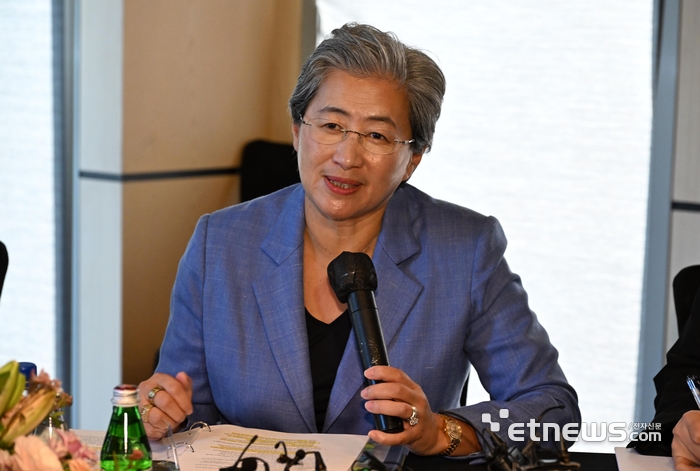
Lisa Su, chair of AMD, announced on Oct. 7 that the company plans to establish an “AMD Artificial Intelligence (AI) Research Center” in South Korea within the year and hire hundreds of research personnel. This is a follow-up measure to the memorandum of understanding (MOU) exchanged between the Ministry of Science and ICT and AMD on the occasion of President Lee Jae-myung's San Francisco AI Summit in July.
Ryu Je-myeong, second vice minister of science and ICT, and Su met at the Four Seasons Hotel in Seoul on the day and held a roundtable in which 14 domestic AI semiconductor and software (SW) companies participated. As the event, originally scheduled for Oct. 8, was moved forward by a day due to Su's schedule, Vice Minister Ryu attended instead of Deputy Prime Minister Bae Kyung-hoon.
In her meeting with Ryu, Su said, “We are pushing to establish a Korean AI 'Center of Excellence (COE)' and plan to hire hundreds of AI research personnel.”
A COE is a core organization where companies and other entities aggregate research, validation, and talent cultivation functions for specific fields. AMD's Korean COE is undergoing working-level consultations with the goal of being established within the year. The government will determine the location, while AMD will be in charge of investments such as hardware. Specific details are scheduled to be prepared at next month's steering meeting, and once the organization opens, it is expected to become AMD's first COE in the Asia-Pacific region.
AMD's existing COEs were created when AMD had previously invested locally or when there was a strategic need to perform large-scale projects. The Korean center is drawing attention as it is the first case being promoted triggered by a memorandum of understanding without trillion-won-scale facility investments or confirmation of specific contract orders.
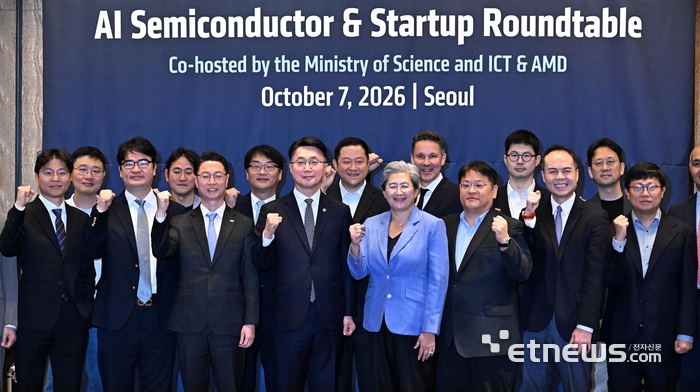
Su also emphasized collaboration with Korean companies to expand AMD's open ecosystem. She conveyed a strategic direction to allow the selection of not only graphics processing units (GPUs) but also other accelerators through its software platform 'ROCm (Radeon Open Compute)'. Other accelerators encompass domestic neural processing units (NPUs) produced by FuriosaAI, HyperAccel, and Mobilint, which participated that day.
ROCm is AMD's open computing software platform. If Nvidia's 'CUDA' is a development environment for running artificial intelligence models on its own graphics processing units, ROCm serves that role on AMD chips. It consists of drivers, compilers, libraries, and development tools, and offers high accessibility as open-source software.
On this day, attendees also discussed heterogeneous AI computing that bundles AMD's central processing units and graphics processing units with domestic neural processing units into a single system. As the market center shifts from training to inference, it has been judged that lowering inference costs and power consumption by connecting different semiconductors and software has become more important than the performance of a single chip.
Both sides agreed to implement this into actual infrastructure and develop it into a reference model that can be utilized in the global market through domestic verification. Investments are also underway to increase AI computing capacity in South Korea for domestic startups and users to utilize. The cloud collaboration case between AMD and MangoBoost, constructed for the purpose of inference serving, was also mentioned.
“Making it easy for users to choose whichever hardware they want, whether graphics processing units or accelerators, is AMD's philosophy, and ROCm is that pathway,” Su explained. “We are also open to collaborations that connect central processing units and various accelerators.”
On the same day, Su moved to Dragon City in Yongsan-gu to have time to communicate with Korean gamers. Afterward, she is scheduled to carry out meetings with management of partner companies, including Jun Young-hyun, vice chairman of Samsung Electronics Co., and Kwak Noh-jung, president of SK Hynix Inc.
“I came (to South Korea) to meet partners, and I will meet Samsung and also SK Hynix,” Su emphasized. “AI is the fastest-moving field in my career, and visiting South Korea and regularly communicating with partners is important in responding to the market.”
