








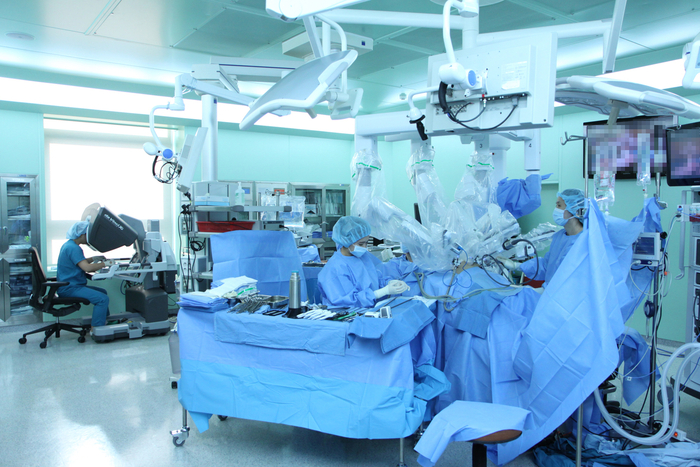
Major South Korean hospitals are expanding single-port robotic surgery—using only one incision—to high-difficulty cancer procedures. As the competition for cumulative robotic surgery cases has become standardized across tertiary hospitals, institutions are shifting focus to expanding applicable cancer types, developing proprietary techniques, and securing evidence for international journals.
According to medical sources on the 5th, Samsung Seoul Hospital has established evidence for single-port (SP) robotic surgery for esophageal cancer, the most delayed in commercialization. The research team led by Professor Park Sung-yong from the Department of Thoracic and Esophageal Surgery published the outcomes of single-port esophageal cancer surgery via intercostal access in the Japanese Society for Esophageal Diseases' journal *Esophagus*. This marked the first official academic report of such clinical results.
The team compared 104 multi-port and 21 single-port cases performed between December 2024 and November of last year. There were no differences in operation time, number of resected lymph nodes, hospital stay, pain, or complications. The complete resection rate (R0) was also similar.
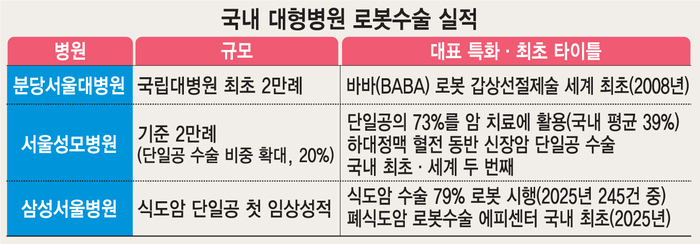
Single-port surgery showed less blood loss. The hospital was also named Korea's first robotic surgery training hub (epicenter) for lung and esophageal cancer. Of the 245 esophageal cancer surgeries performed in-house, 79% were robotic.
Seoul St. Mary's Hospital is accumulating superior cases in urological cancers. Of its 20,000 robotic surgeries, 3,798 (20%) were single-port. As of 2024, 73% of single-port procedures were for cancer treatment—significantly higher than the national average of 39%.
The hospital achieved 1,000 single-port urological robotic surgeries first in Asia-Pacific, with 87% involving cancer patients. Notably, Professor Hong Seong-hoo's team performed a single-port retroperitoneal approach for an 8cm kidney cancer with inferior vena cava thrombus invasion—the first in Korea and second globally.
Bundang Seoul National University Hospital became the first national university hospital to surpass 20,000 robotic surgeries. It pioneered the BABA (Bilateral Axillo-Breast Approach) robotic thyroidectomy, which leaves no neck scars.
Robotic surgery and advanced surgical techniques are expanding alongside the related market. According to Intuitive Surgical Korea, domestic robot-assisted surgeries grew eightfold from approximately 10,000 cases annually in 2015 to around 80,000 cases last year. Initially centered on urology, the technology has expanded to general surgery, obstetrics and gynecology, head and neck surgery, and thoracic surgery.
Hospital strategies vary, but there is a common trend toward applying single-port techniques to high-complexity cancers. However, single-port methods cannot fully replace existing approaches. The choice between single-port and other techniques depends on tumor location, stage, and patient condition, as each method has distinct advantages and limitations.
The accumulation of evidence supporting robotic surgery expansion is intertwined with discussions on insurance reimbursement. The Health Insurance Review & Assessment Service (HIRA) has initiated a re-evaluation of 54 robotic surgery indications where clinical utility is comparable to or exceeds conventional surgery, assessing safety and efficacy on a per-indication basis.
In other countries, Japan recognizes separate reimbursement codes only for prostatectomies and partial nephrectomies. Taiwan applies the same reimbursement rate for robotic prostatectomies as for laparoscopic procedures, with patients covering material costs. In South Korea, robotic surgery remains non-reimbursable, with costs ranging from 10 million to 25 million KRW.
Darae Strategic Commercialization Center Supports Business Meetings with Global Big Pharma at 'BIO USA 2026'…Securing a Foothold for K-Bio's Overseas Expansion
[Darae Strategic Commercialization Center] Newsroom Link〉
A medical industry insider noted, “If robotic surgery gains insurance coverage, fixed reimbursement rates and bundled material costs will reduce hospital margins while increasing prescription volumes. Ultimately, hospitals may pressure medical robot suppliers to lower prices for high-cost consumables like robotic arms, which constitute a significant portion of surgical expenses.” They added, “Global leaders with high market share may hesitate to lower prices in Korea, fearing a global price decline. This gap could create opportunities for domestic and international late-stage surgical robot manufacturers.”
