






China is revising a series of energy-efficiency and safety standards for household appliances, expanding the scope from air conditioners and air purifiers to refrigerators, washing machines, dishwashers, and other major appliances.
Products manufactured in China will need to undergo retesting, certificate conversions, and, in some cases, changes to refrigerants, components, and materials. The shift is expected to increase sourcing costs for South Korean small and mid-sized appliance companies that have relied on Chinese original design manufacturers (ODMs) for competitively priced products.
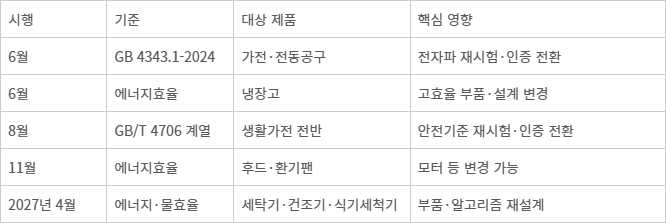
According to the home-appliance industry, China began enforcing its revised general safety standard for household and similar electrical appliances, GB/T 4706.1-2024, on Aug. 1. Product-specific safety standards covering air purifiers, refrigerators, washing machines, dryers, dishwashers, range hoods, and air conditioners were revised at the same time.
In June, China also implemented the mandatory national standard GB 4343.1-2024, overhauling electromagnetic compatibility (EMC) testing requirements for household appliances and power tools. The China Quality Certification Centre (CQC) is requiring even previously certified products to undergo supplementary testing and convert their existing certificates.
Certificates that are not converted by the deadline may be suspended or revoked. Manufacturers that wish to continue producing the affected products will therefore need to bear the cost of retesting and renewing their certifications.
The more significant issue may be China's separate overhaul of energy-efficiency regulations, which could require changes to product designs. China replaced its refrigerator energy-efficiency standard in June and will introduce revised standards for range hoods and ventilation fans in November.
In April next year, China will also revise energy- and water-efficiency standards for washing machines, washer-dryers, and dishwashers.
Depending on the product, meeting the stricter standards may require manufacturers to redesign components and operating algorithms, including compressors, motors, inverters, insulation materials, and sensors. The changes could increase not only certification expenses but also development and component costs.
The financial impact is already becoming clearer. An analysis report by the Korea Accreditation Board, released through the Technical Barriers to Trade (TBT) Comprehensive Support Center under the Korean Agency for Technology and Standards, estimated that testing costs to obtain China Energy Label (CEL) certification for unitary air conditioners could range from several million KRW to around 15 million KRW per model.
Products that fail to meet the new efficiency requirements may need higher-efficiency compressors, heat exchangers, and other components, followed by renewed design validation and performance testing. South Korea's exports of unitary air conditioners to China totaled USD 71.515 million last year.
Chinese ODM products, long used by South Korean appliance companies as a low-cost sourcing option, are also likely to become more expensive. ODM suppliers using common production lines and components for both domestic Chinese and export products may pass on the costs of retesting and design changes through higher supply prices.
“Samsung Electronics and LG Electronics have been reducing their retail presence in the Chinese market,” an industry official said. “As a result, the impact of China's successive regulatory changes is expected to be greater for small and mid-sized Korean appliance companies that rely on Chinese ODM and OEM suppliers than for companies exporting directly to China.”