








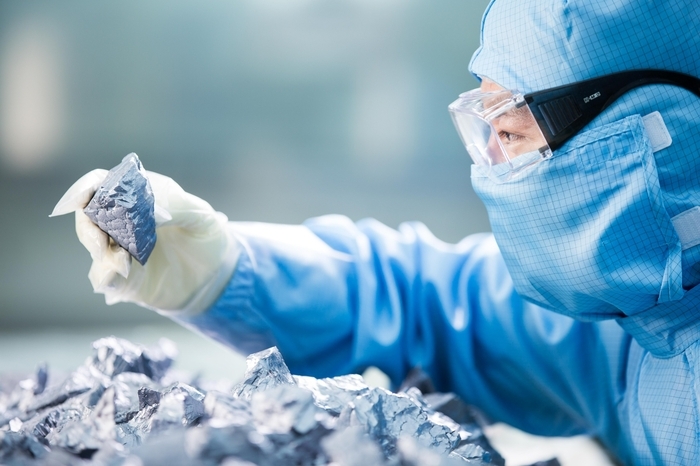
As U.S. President Donald Trump enforced measures under Section 232 of the Trade Expansion Act, introducing a minimum import price system and imposing a 15% tariff on polysilicon and derivative products, the South Korean government and industry have initiated emergency responses. Polysilicon is an indispensable core material for producing semiconductor wafers and solar cells/modules. The government and industry are closely reviewing whether these measures will impact Korean companies' exports to the U.S. and the global supply chain.
The Ministry of Trade, Industry and Energy held an emergency public-private joint strategy meeting on the 11th at the Korea Chamber of Commerce and Industry in Seoul, led by Deputy Minister for Trade Negotiations Park Jung-sung, with major companies including Samsung Electronics, Hanwha Q CELLS, SK Siltron, and OCI, to begin preparing countermeasures.
The U.S. government previously announced on the 6th (local time) regulatory measures on imported polysilicon under Section 232 of the Trade Expansion Act. The key measure is imposing an additional 15% tariff on polysilicon derivatives such as ingots, wafers, and cells. Additionally, minimum import prices were set for each item: $21 per kilogram for polysilicon, $100 per kilogram for ingots/wafers, $0.22 per watt (W) for solar cells, and $0.38 per watt for solar modules.
The meeting examined not only the short-term impact of the U.S. regulatory measures on major export items of Korean companies but also the direct and indirect effects on the entire supply chain of companies that have made large-scale investments in the U.S. The Korea Semiconductor Industry Association presented an analysis of the impact on the supply chains of companies exporting polysilicon derivatives to the U.S. and those operating there, while participating companies shared their analysis of the impact on their U.S. operations and their own response plans with the government.
However, some industry experts and analysts suggest that the U.S. tariff measures could serve as an opportunity for growth rather than just a crisis for Korean companies. The dominant interpretation is that the real target of the Section 232 invocation is “China,” which virtually monopolizes the global solar supply chain. Due to the U.S.'s high tariffs and strict minimum import price system, low-cost Chinese polysilicon and solar derivatives, which have relied on price competitiveness, will face significantly higher barriers to entering the U.S. market.
If Chinese products are marginalized or excluded from the U.S. market, Korean companies with quality and technological capabilities are expected to benefit relatively. In particular, Korean solar and semiconductor material companies already present in the U.S. or with high export shares to the U.S. could fill the void left by China, gaining indirect benefits and expanding their market share in North America.
The Ministry of Trade, Industry and Energy plans to analyze the industry's concerns and market opportunities gathered during the meeting and expedite follow-up measures to minimize negative impacts on companies' import and export operations. To this end, it will maintain close communication channels with the industry for rapid information sharing on the U.S. government's specific guidelines and market fluctuations. Additionally, it plans to operate various channels for negotiations with the U.S. to help Korean companies leverage these measures as a foothold for expanding into the U.S. market.
Deputy Minister for Trade Negotiations Park Jung-sung stated, “We will provide necessary support from the government at the right time and place.”
