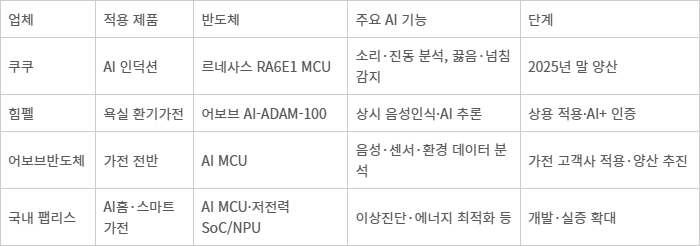







The artificial intelligence (AI) home appliance trend is spreading beyond large appliances to small and household electronics such as induction cooktops and ventilation appliances.
On-device AI, which implements necessary AI functions at the microcontroller unit (MCU) level at a low cost without a separate neural processing unit (NPU), is gaining traction.
According to market research firm ABI Research, excluding smartphones and PCs, shipments of AI semiconductors for TinyML are projected to grow at a compound annual rate of 37% from 2026 to 2031, surpassing 4.1 billion units in 2031. The related market revenue is also expected to exceed $7.8 billion. ABI Research anticipates that MCUs will lead the TinyML semiconductor market until 2031.
TinyML is a technology that enables small AI models to operate on MCUs with limited computational and memory resources. It allows specific functions, such as analyzing sensor data like sound, vibration, or temperature, to be implemented without high-performance AI chips.
An MCU is a component that reads sensor data and controls devices in a predefined manner. Existing MCUs for home appliances are low-cost chips priced in the hundreds to thousands of won per unit when purchased in bulk. From the perspective of appliance manufacturers, the advantage is that they can add minimal AI processing to existing control functions without significantly increasing product costs or power consumption.
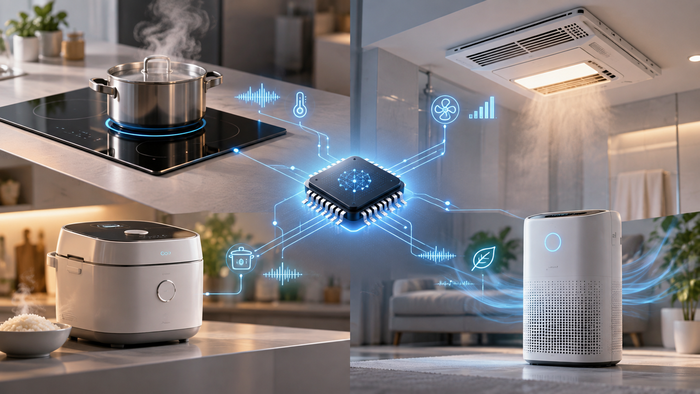
Actual applications are now expanding into mid-tier and everyday home appliances. Cuckoo applied Renesas' RA6E1 MCU to its AI induction cooker. The MCU analyzes sound and vibration to detect when water or food is boiling over and automatically adjusts the heat. Mass production began at the end of last year.
Himpeel also incorporated Above Semiconductor's AI MCU 'AI-ADAM-100' into its bathroom ventilation system. It performs continuous voice recognition and AI inference within the MCU without requiring a separate high-performance processor or cloud connectivity. Himpeel's product has also obtained the Korea Standards Association's AI+ certification.
Demand for AI MCUs is rapidly expanding. Above Semiconductor counts Samsung Electronics, LG Electronics, Chinese brands Midea, and Xiaomi among its home appliance MCU customers. This indicates that AI functionality is spreading not only in large domestic appliance companies but also in Chinese home appliances. Above Semiconductor is developing AI MCUs that integrate AI processing capabilities and is pushing for product application and mass production.
As AI home appliances expand from premium products like refrigerators, washing machines, and air conditioners to everyday appliances such as cooking, ventilation, and air management, the applications for AI MCUs are expected to grow. In the future, specialized AI functions for each product—such as anomaly detection, energy optimization, and user behavior recognition—are anticipated to be embedded in MCUs, beyond just voice recognition.
AI features are also being rapidly adopted in food waste processors and institutional cooking equipment. In China, MCU manufacturers like HiSilicon and Gigadevice are strengthening AI and TinyML capabilities for home appliances and expanding the market. Domestically, Above Semiconductor began classifying AI MCUs as an independent product category, separate from general-purpose MCUs, starting with its mid-year report this year.
An industry insider stated, “In home appliances, the key is not high AI processing performance itself but how efficiently the required functions can be implemented with low power and cost.” They added, “As AI models become more lightweight and the range of processing capabilities within MCUs expands, the number of AI-applied products will grow rapidly.”