







The government will remove regulations and licensing hurdles at cutting-edge industrial sites such as semiconductors, secondary batteries, and biotechnology, accelerating corporate investments worth approximately KRW 4.3 trillion. It will immediately simplify factory expansion permits in the Yongin Semiconductor Cluster and allow secondary battery recycling companies to enter industrial complexes.
On the 13th, the government announced the “On-Site Corporate Investment and Innovation Support Plan” during the Emergency Economic Headquarters Meeting and Economic Ministers' Meeting, chaired by Deputy Prime Minister and Minister of Economy and Finance Koo Yun-chul.
This measure focuses on connecting “on-site pending projects”—which were delayed due to regulation and licensing issues despite confirmed corporate demand—to actual investments. The investment size for major projects stands at a total of KRW 4.28 trillion, including KRW 100 billion for secondary batteries, KRW 2.5 trillion for the Yongin Semiconductor Cluster, KRW 800 billion for semiconductor verification facilities, KRW 530 billion for biotechnology, and KRW 350 billion for food.
First, companies in secondary battery recycling-related sectors will be allowed into the Gumi and Pohang National Industrial Complexes. Currently, secondary battery resource recycling is a core battery manufacturing method, yet it is difficult to enter industrial complexes as it is classified under waste-related sectors. The government will add manufacturing of recycled lithium, nickel, cobalt, manganese, and graphite to the eligible list to support new investments worth approximately KRW 100 billion.
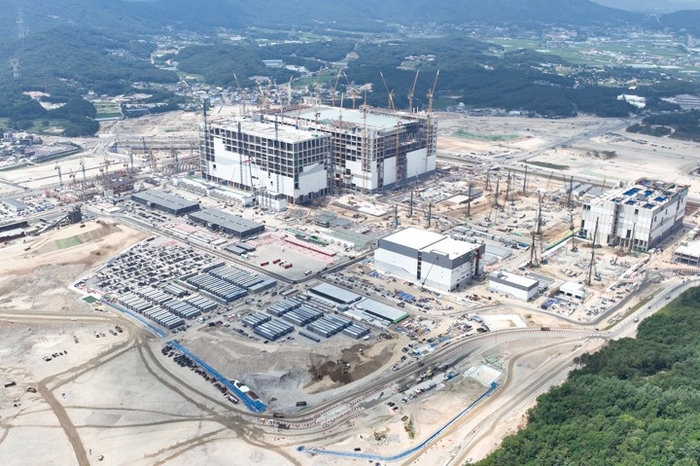
At the Yongin Semiconductor Cluster, regulations requiring modifications to existing building permits for every factory expansion will be improved. Amendments to the Building Act will be pursued so that industrial complexes above a certain size can obtain separate permits for expanded buildings, detached from existing building permits. Through this, early execution of investments worth about KRW 2.5 trillion will be supported.
Support for semiconductor equipment, materials, and components verification will also be strengthened. Gift taxes will be exempted from 2027 to 2031 on properties or profits donated to corporate bodies operating verification testbeds based on contributions from semiconductor companies. This measure is intended to back the construction of the “Trinity Fab,” a KRW 800 billion semiconductor 5-major process verification facility.
In the biotechnology sector, green spaces owned by Cheongju City within the Ochang Scientific Industrial Complex will have their land use changed to industrial land to support factory expansions connected to existing manufacturing facilities. This is an investment worth approximately KRW 530 billion. In the Iksan National Food Cluster in North Jeolla Province, beverage manufacturing sites with low sales rates will be expanded to food and beverage manufacturing sites, promoting investments worth about KRW 350 billion.
Regulations unsuitable for cutting-edge and new industries will also be overhauled. Guidelines for applying KS and ISO safety standards will be established so that collaborative and mobile robots can be utilized at industrial sites, and the definition of industrial robots will be refined to encompass new types of robots. Fire safety performance-based design using computer simulations will be introduced for six key strategic industries: semiconductors, secondary batteries, displays, biotechnology, robotics, and defense.
The safety inspection period for urban gas expansions at semiconductor fabs will be shortened from seven days to three days. When necessary for new industries or RE100, the limit for designating restricted-industry planning zones, where all business types are permitted to enter, will be expanded from 30% to 50% of total industrial land area. The maximum designation area for Opportunity Development Zones outside the capital region will also be expanded to reflect new investment demands.
Following this first set of measures, the government plans to release a second investment package in the third quarter, focusing on leading projects for a hyper-innovative economy and green industries.
Joo Hwan-wook, policy coordination director at the Ministry of Economy and Finance, said, “We plan to swiftly prepare a second set of measures centered on leading hyper-innovative economy projects and green industries to actively back corporate innovation and investment.”
