








A KRW1 trillion “LP Growth Fund” will be launched to attract private capital from pension funds, the financial sector, and industry into the venture capital market. The government plans to build a private sector-led venture investment ecosystem by reducing the fiscal contribution ratio of the Fund of Funds while offering incentives such as first-loss protection and put options to private limited partners (LPs).
The Ministry of SMEs and Startups (MSS) and Korea Venture Investment Corp. (KVIC) announced the initiative during the “LP Growth Fund Launch Ceremony” held at the Startup Venture Campus (SVC) Seoul in Mapo-gu, Seoul, on the 13th.
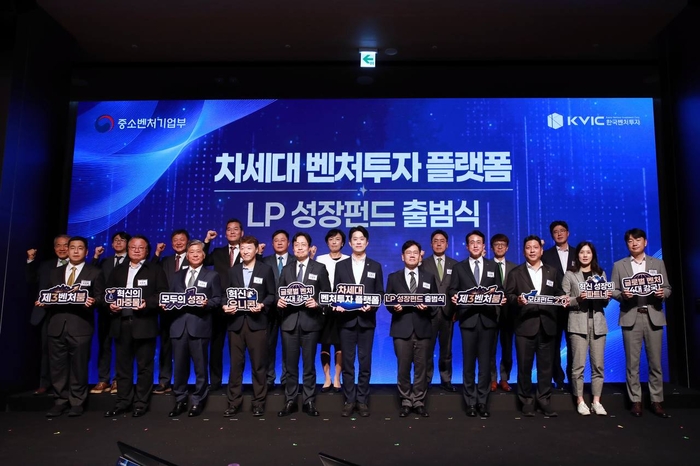
The LP Growth Fund is an investment platform designed with customized structures for various institutional investors, including pension funds, the financial sector, and corporate industries, to participate in venture capital investments. The government designs a two-track investment program using either sub-fund or master-fund approaches and offers benefits such as first-loss absorption and put options to induce the inflow of private capital into the venture market.
Currently, 18 institutions have decided to commit capital. Among them, five institutions—the National Sports Promotion Fund, the Supply Chain Stabilization Fund, the Export-Import Bank of Korea (KEXIM), Korea Medical Institute (KMI), and Far East Logistics Group—are contributing to venture investment funds for the first time through this LP Growth Fund.
Participation by pension funds is also expanding. Three pension funds—the National Sports Promotion Fund, the Industrial Accident Compensation Insurance and Prevention Fund, and the Supply Chain Stabilization Fund—have confirmed their commitments. In addition, multiple other pension funds are reviewing whether to make final investments. MSS projects that if these entities participate, pension fund commitments will increase more than fivefold compared to last year.
When private investors contribute KRW340 billion, the Fund of Funds will match KRW170 billion, resulting in a joint public-private investment of approximately KRW510 billion. With additional commitments from venture capital (VC) firms, the plan is to ultimately form a venture fund totaling around KRW1 trillion.
Kim Chan, head of the Fund Management Office at the National Sports Promotion Fund, said, “As the fund's scale continues to grow, the need to expand alternative and venture investments to improve mid-to-long-term returns has increased. Amid structural industrial changes like AI, we expect venture investments to lead to stable long-term returns and will actively align with the government's productive finance policies.”
The government will significantly lower its fiscal proportion. Normally, government funding accounts for around 60% of total commitments in Fund of Funds investment projects, but the LP Growth Fund lowers this fiscal ratio to 20% and raises the proportion of private capital to 80%. MSS expects this to increase the multiplier effect of government spending by more than five times.
Funds investing in strategic industries such as defense, artificial intelligence (AI), beauty, and biotechnology will also be formed. A defense-specialized fund worth KRW110 billion will be created with a consortium consisting of the Export-Import Bank of Korea and BNK Financial Group. Large, medium, and small enterprises—including Naver, Hyosung, GS, Sunic System, Far East Logistics Group, and Taehwa Group—will also participate to form open innovation funds worth approximately KRW250 billion to invest in AI, beauty, biotech, and defense.
Noh Hae-dong, executive director at Busan Bank, said, “Unlike traditional investment methods, the greatest advantage of the LP Growth Fund is that investors can directly select investment fields and targets, enabling investments tailored to regional industrial characteristics,” adding, “We decided to invest because we believe we can serve as a strategic investor supporting the growth of regional industries and venture companies, beyond being a simple financial investor.”
With the launch of the LP Growth Fund, the government intends to expand the role of the Fund of Funds from a traditional finance-centered seed capital supplier into an investment platform connecting private capital to the venture market.
Noh Yong-seok, first vice minister of MSS, said, “Going beyond the role of a seed capital provider, the government must prepare for the Fund of Funds 2.0 era, which directs accumulated national capital to flow into venture capital,” adding, “We will reflect the voices from the field raised at the launch ceremony and forum to strengthen the Fund of Funds' role as a next-generation venture investment platform.”
The first investment announcement for the LP Growth Fund will be issued on the 14th. MSS plans to launch full-scale fund formation procedures, including selecting general partners (GPs) within the fourth quarter.
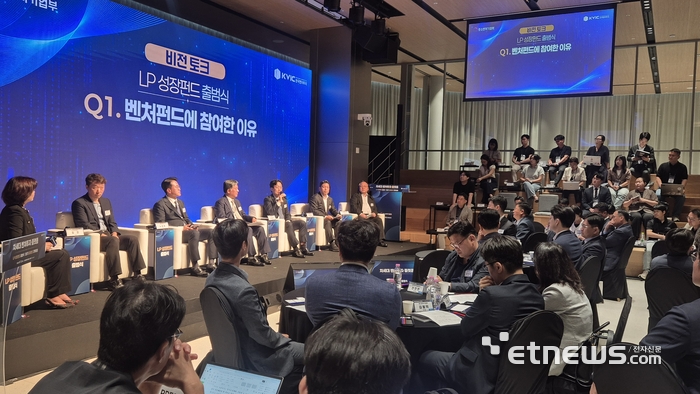
Following the launch ceremony, the 3rd Quarter Fund of Funds Policy Forum was held under the theme “Rediscovery of Venture Investment as a Private Capital Management Vehicle.” Discussions focused on tasks required for private investors—such as pension funds, mutual aids, asset managers, and major corporations—to utilize venture investments as long-term asset allocation vehicles.
Attendees emphasized that to expand the inflow of private funds into the venture market, not only investments but also the exit market must be revitalized simultaneously. Joo Su-yong, senior managing director at Mirae Asset Global Investments, said, “Venture funds are an attractive asset class where long-term compounding effects and high returns can be expected,” but noted, “To reduce short-term evaluation burdens and exit period uncertainties, the secondary fund and existing share trading markets must be activated.”
Opinions were also raised that corporate venture investments should be expanded from simple financial investments into strategic investments. Noh Kyu-seung, executive director at Hyundai Motor Group, said, “For corporate LPs, venture investment is a strategic asset to secure future technologies such as physical AI, robotics, and on-device AI,” adding, “Investment value can be maximized only when linked with practical Proof of Concept (PoC) and business cooperation with large corporations.”
From the perspective of institutional investors, stable exit performance and general partner (GP) capabilities were presented as core conditions for expanding private capital. Choi Hong-seok, division head at the Korean Teachers' Credit Union (KTCU), emphasized that since yield gaps among GPs are wide, it is necessary to select fund managers meticulously by closely evaluating track records and risk control capabilities.
Park Ki-ho, CEO of LB Investment, proposed utilizing the “private capital attraction multiplier”—which shows how much private investment policy finance has leveraged—as a key performance indicator (KPI). Along with this, he emphasized that building long-term partnerships between LPs and GPs and diversifying the exit market through secondary funds must be pursued concurrently.
