








Digital Product Passport Registry Launched
Managing Even Parts and Recycling Data
Repairability Grade Labeling Next Year as Well
Emergency Response for S. Korean Firms Across Entire Product Lifecycle
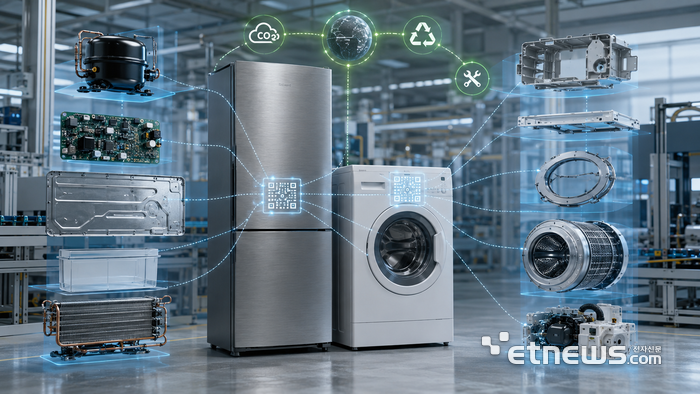
Environmental, Social, and Governance (ESG) regulations of the European Union (EU) are expanding to individual products. Going forward, products that do not clearly specify parts supply, disassembly, repairability, and other details will face difficulty being launched in the EU market.
South Korean exporting companies have taken on the task of connecting supply chain data while simultaneously rebuilding their spare parts supply and repair service (A/S) systems. Due to the expansion of regulations based on product data, an impact on South Korea's exporting companies is inevitable.
According to related industries on August 17, the EU launched the Digital Product Passport (DPP) registry last month. The DPP is a 'digital identity card for each product' that assigns a unique identification number to a product and connects material composition, carbon footprint, repair, and recycling information. Consumers, repair companies, recyclers, and customs/market surveillance authorities can check information according to their authorization through identification means such as QR codes attached to the product.
Following the operation of the DPP registry, the right to repair directive at the major EU member state level, such as Germany, also entered implementation procedures this month. In accordance with EU policy, member states other than Germany are also scheduled to sequentially finalize legislation.
The right to repair directive is a system that allows asking manufacturers for repairs even after the statutory warranty period. Washing machines, dishwashers, refrigerators, smartphones, and other products are subject to coverage. Manufacturers must not only support repairs after the warranty period, but also supply repair parts and tools. Acts of prohibiting independent repair shops from using compatible or used parts through software (SW) or other means will also become impossible.
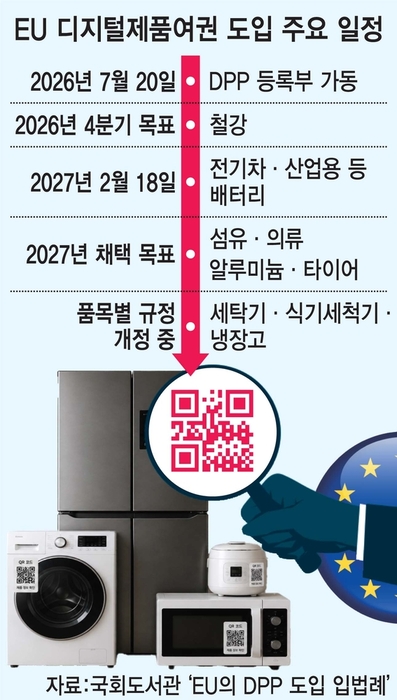
The EU is also preparing 'horizontal repairability' requirements to be commonly applied to multiple product categories under the Ecodesign for Sustainable Products Regulation (ESPR). It is preparing detailed standards with the goal of introduction in the home appliance sector next year. Consumer electronics and small home appliances exported to the EU must register spare parts supply periods, delivery periods, parts prices, tools, software support periods, and other information in the DPP. Products that fail to meet the minimum requirements will be restricted from launch. Right away starting January next year, clothes dryers are mandated to display repairability grades on energy labels.
In some appliance sectors such as smartphones, repairability is used as a product evaluation index. As a result of evaluating repairability by the Public Interest Research Group (PIRG), a U.S. consumer group, Apple received a D- grade and Samsung Electronics received a D grade. If DPP implementation begins in earnest, products with low repairability grades are likely to be excluded from consumer choice. Additional cases similar to Apple previously scrapping its proprietary standard and switching its charging terminal to USB-C could occur.
Industry is expressing difficulty over the pressure of environmental regulations expanding on a product unit basis. As these are market entry rules set by the EU, it is difficult to request regulatory relaxation or deferral domestically. The atmosphere is that the only options companies can choose are investing costs to rebuild product design, parts supply, repair networks, and data systems, or reducing low-profitability products and export volumes.
An industry official anticipated, “European regulations are not a matter where domestic companies can request to adjust implementation timing or standards, so it is difficult to expect any noticeable support measures other than support for certification costs,” adding, “If parts, repair networks, and related data are maintained for a long period even for products with low sales volume, business feasibility may not emerge, making the choice to give up European launches for some products inevitable.”
