






Leaders from Samsung Display, Google and Meta have identified artificial intelligence and extended reality as the next major drivers of display innovation. The industry is moving beyond a simple race for better image quality toward a broader competition in AI-integrated displays, advanced optics and wearable XR devices designed for everyday use.
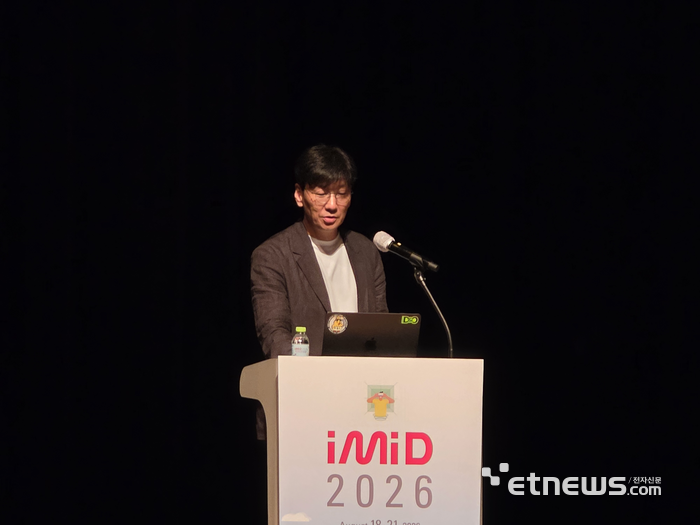
At the IMID 2026 conference in Busan on Aug. 19, Cho Sung-chan, executive vice president and head of Samsung Display's Display Research Center, said text- and voice-based communication have inherent limits in the AI era.
“Intuitive, visual experiences delivered through displays will become a core means of communication in the age of AI,” Cho said.
He outlined three areas Samsung Display is prioritizing for next-generation displays: diversified form factors, ultra-low power consumption and context-aware capabilities.
To expand form factors, Samsung Display is developing curved and free-form displays for a broader range of objects and applications, including wearable pendants, smart hand warmers and humanoid-robot surfaces. The company is also pursuing microdisplay technology by combining display and semiconductor expertise, targeting AR and VR wearables as well as emerging applications that require ultra-high resolution and extremely high pixel density.
Samsung Display has also introduced next-generation architectures, including polarizer-free display technology designed to improve optical efficiency and significantly reduce power consumption. In parallel, it is strengthening context-aware technology by integrating sensing and data-processing functions directly into displays.
Google and Meta highlighted smart glasses as a leading application for AI-enabled displays and outlined their respective display strategies.
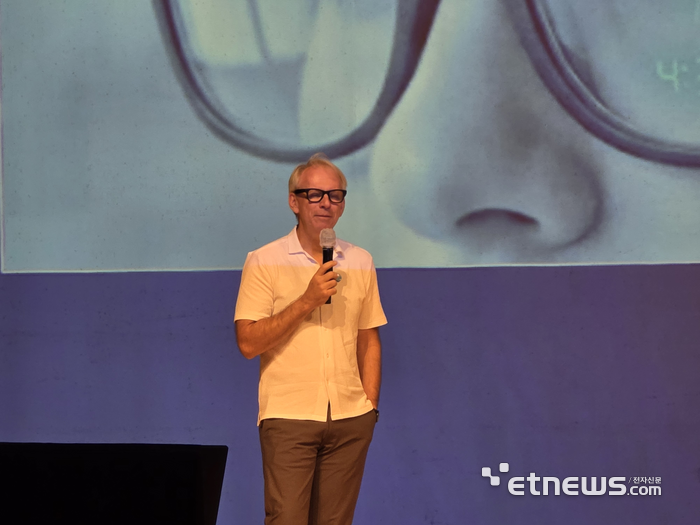
Bernard Kress, director of optics for Google Android XR, said three forces are driving smart glasses toward mass adoption: a more mature AR hardware ecosystem, general-purpose operating system platforms such as Android XR, and the emergence of multimodal AI assistants including Gemini and Meta AI.
“Multimodal AI that sees what users see and hears what users hear is the true use case that people have been waiting for,” Kress said.
For compact glasses form factors, Kress expects optical architectures to evolve from liquid crystal on silicon, or LCoS, engines toward single-panel red, green and blue micro-LED systems and X-Cube optical architectures, which could offer advantages in miniaturization and brightness.
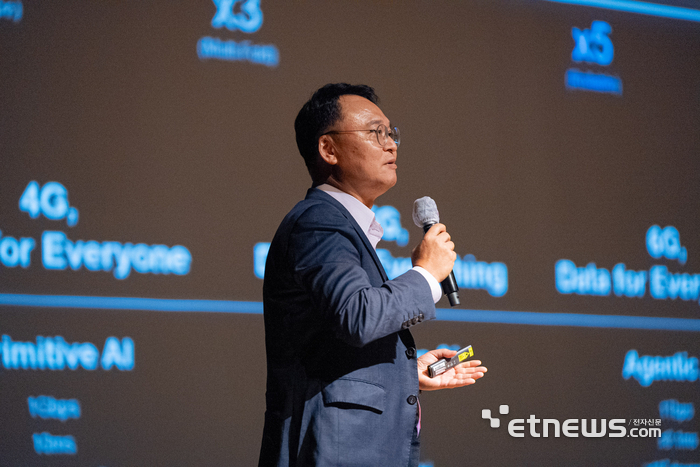
Jacob Choi, a director at Meta Reality Labs, said VR and mixed-reality devices must achieve retina-level resolution and ultra-low power consumption to evolve from bulky headsets into glasses that can be worn every day.
Meta is pursuing what it calls a “Display Moore's Law” roadmap, aiming to increase pixel density per unit area by roughly 1.5 times with each generation without increasing power consumption—an approach modeled on the semiconductor industry's scaling principles.
Choi said Meta is pursuing a two-track strategy: ultra-high-resolution manufacturing technology centered on liquid crystal displays, and micro-OLED displays using complementary metal-oxide-semiconductor, or CMOS, silicon backplanes.