








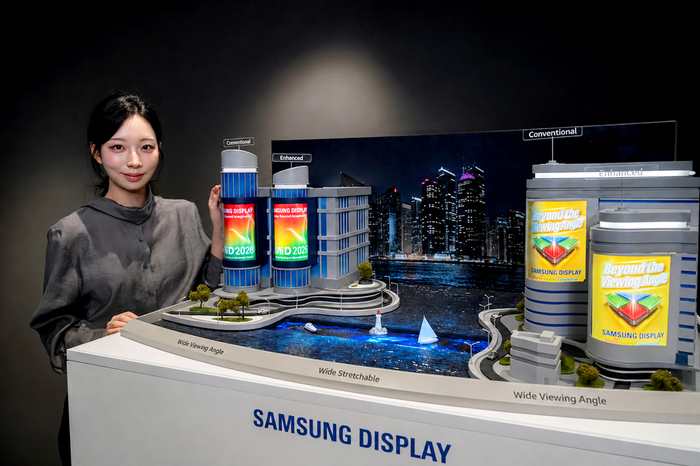
'Foldable wide viewing angle Organic Light Emitting Diode (OLED)' 'OLED without Fine Metal Mask (FMM)' 'Wide stretchable display'
Samsung Display and LG Display, South Korea's two major display companies, unveiled panels applying new technologies side-by-side at 'IMID 2026', the nation's largest international display academic conference, which opened on August 19 at BEXCO in Busan hosted by the Korean Information Display Society (KIDS).
The highlight is the wide viewing angle technology that overcomes existing limitations of foldable phones, which are considered next-generation form factors. Samsung Display's 7.6-inch foldable wide viewing angle OLED prototype completely redesigned the new organic light-emitting layer materials and structure, allowing users to see a bright and uniform screen without luminance degradation even at the curved sections when viewed from the front.
Currently commercialized foldable displays have a structural issue with flexible displays that bend, resulting in the brightness of the curved sides of the fold area being only about 40% compared to the front.
Visitors also showed curiosity about the stretchable display that flexibly stretches its screen. The 20-inch screen size 'wide stretchable' showcased by Samsung Display features expanding the screen size by more than two times by applying tiling technology that connects two existing stretchable displays as if they were a single screen.
“Enlarged stretchable displays will be utilized in various fields requiring curved surfaces, including digital cockpits for automotive use, humanoids, and digital signage,” an official at Samsung Display said.
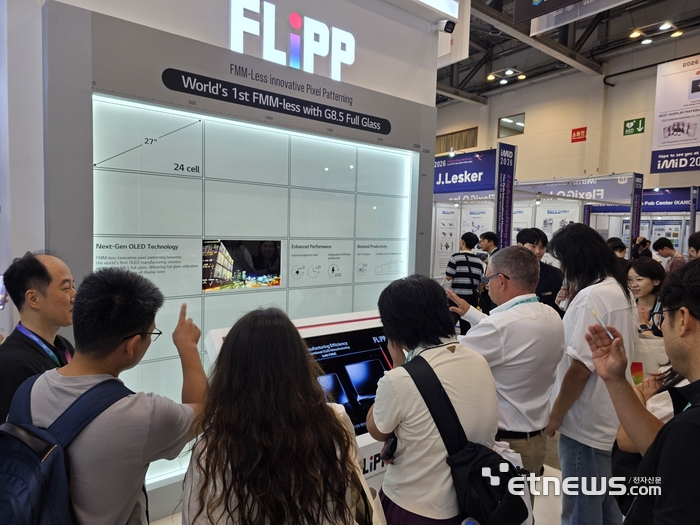
LG Display attracted industry attention by exhibiting a 27-inch panel of photolithography deposition method OLED named 'FLiPP', manufactured with Generation 8.5 large-scale OLED equipment. Photolithography deposition technology patterns pixels by sequentially applying red, green, and blue pixels to precise locations across the entire substrate, fixing them, and then precisely erasing unnecessary parts using ultraviolet (UV) light.
While it is not the first attempt at this technology, such as Japan Display's 'eLEAP' or China Visionox's 'ViP', LG Display explained that it is the first panel made with Generation 8 equipment.
Its advantage is that it can overcome the limitations of the FMM (a component used to deposit red, green, and blue organic materials at exact locations) method, which is a mass production technology.
The aperture ratio, which is the proportion of area occupied by pixels in the total display, is also about 55% higher compared to the FMM method. Because of this, luminance can be improved by 1.6 times, lifespan increased by 2.4 times, or power consumption reduced by 13% compared to the FMM method.
According to the industry, LG Display adopts a horizontal deposition method, unlike conventional photolithography OLEDs that use vertical deposition. It is understood to have plans to replace its existing Paju White (W) OLED line with a dedicated FLiPP line.
“Rather than small and medium-sized displays currently mass-produced with FMM, we are prioritizing the information technology (IT) market,” an official at LG Display said.
