









LG Display says its next-generation OLED production process, called FLiPP, could open a new path for manufacturing large RGB OLED panels without fine metal masks.
Choi Young-seok, chief technology officer of LG Display, said at IMID 2026 in Busan on Aug. 19 that the technology remains at an early stage, with improvements underway across multiple areas.
“FLiPP is still in its early phase, but we are advancing the technology on several fronts,” Choi said in an interview with The Elec. “We expect it to deliver a paradigm shift on an entirely different level from what has come before.”
FLiPP is LG Display's name for an OLED manufacturing process that forms pixels through photolithography rather than using a fine metal mask, or FMM. The process deposits red, green and blue organic materials across the entire substrate, then uses ultraviolet light to precisely remove unwanted areas and form the pixel pattern.
Panel makers including Japan Display Inc. and China's Visionox have pursued similar technologies. However, the high level of technical difficulty has limited yields, preventing the approach from being widely adopted for mass production.
LG Display used the process on a Generation 8.5 large-area OLED pilot line to produce a 27-inch, 160-pixels-per-inch OLED panel, which it unveiled publicly for the first time at the event.
“The key differentiator is that FLiPP combines our expertise in large-area white OLED manufacturing with photolithography,” Choi said. “Because it is not constrained by panel size or resolution, it can eventually be used for IT products such as tablets and laptops, as well as everything from one-inch-class wearables to ultra-large TVs.”
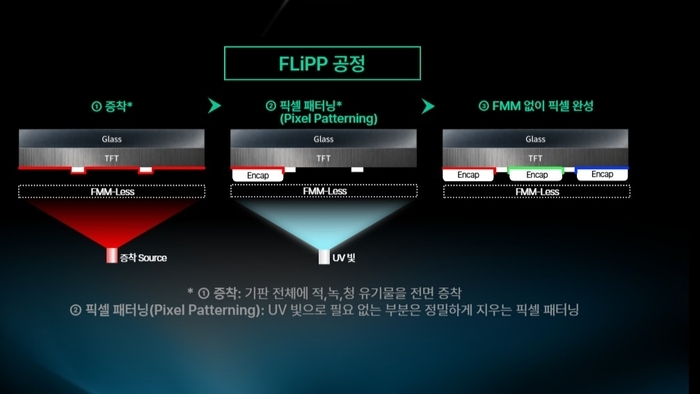
According to Choi, FLiPP removes the limitations imposed by FMM-based production, including restrictions on display size and the cost of changing resolutions.
Conventional FMM processes use extremely fine metal masks to deposit RGB subpixels. When applied to large mother substrates, those masks can sag at the center under their own weight. Producing masks for different resolutions can also sharply increase manufacturing costs.
As a result, LG Display has traditionally used white OLED, or WOLED, for large panels such as TVs and monitors, where FMM production is difficult. It has used RGB OLED for small- and medium-size panels—including smartphones, automotive displays, smartwatches, tablets and laptops—where FMM manufacturing is more practical.
WOLED deposits a white OLED layer across the substrate and creates red, green and blue light using color filters. The approach supports larger panels without FMMs, but it has a structural drawback: more than 25% of light efficiency is lost as light passes through the color filters.
FLiPP enables large panels to be manufactured as RGB OLEDs. Compared with FMM-based OLED production, the process is said to improve aperture ratio—the share of a display area that emits light—by 55%. LG Display said this could translate into 1.6 times higher brightness, 2.4 times longer panel lifespan, or 13% lower power consumption.
“With FLiPP driving a productivity breakthrough and tandem OLED driving innovation in panel structure, we will create a mutually reinforcing technology platform and build a barrier that competitors cannot match,” Choi said.
