








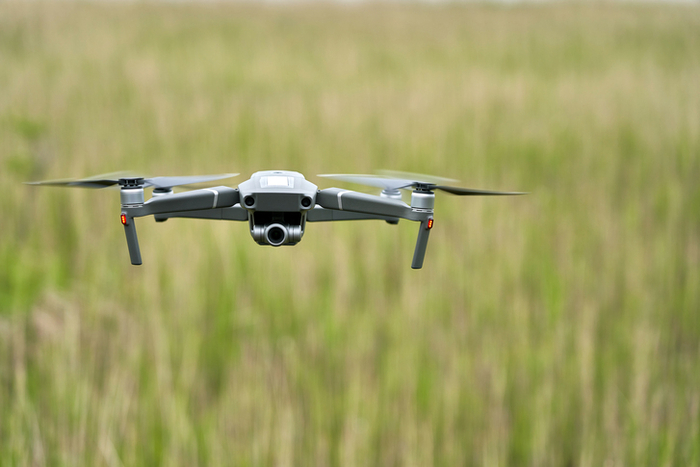
Domestic battery companies, desperate for new sources of demand due to the slowdown in the electric vehicle market, are rushing to develop high-output, high-energy-density batteries for drones and enter supply chains. This comes as the military use of drones has surged following the Russia-Ukraine war, and the United States has strengthened regulations on Chinese drones and components, including batteries.
According to the industry on August 24, NEO Battery Materials Korea recently exported its independently developed domestic drone battery to a Japanese drone company for the first time. This is a sample volume for the Japanese client to verify performance prior to full-scale mass production supply.
The Japanese company, which previously used Chinese batteries, is evaluating NEO Battery's product to secure an alternative supply source, and whether follow-up supply will occur is expected to be decided after flight and performance testing. The company is also discussing the joint development of customized cells for individual aircraft with major domestic drone companies.
“Drones must generate high power from small batteries while flying for a long time,” said Huh Sung-bum, CEO at NEO Battery Materials Korea. “We are developing them with the goal of increasing energy density and power output while simultaneously achieving lightweighting by applying silicon anode materials, among others.”
Vitzrocell, a company specializing in primary lithium batteries, is pushing to enter the military drone battery market. It is discussing battery supply with local companies that supply military drones to the US Department of Defense. Vitzromiltech, an affiliate of Vitzro Group, is also expanding its production capacity after receiving a request from Roketsan, a Turkish defense company, for a large-scale additional supply of military drone batteries.
Requests for drone battery supplies are also continuing for large Korean battery companies. LG Energy Solution has not previously entered the military battery market. However, as the overseas drone market grows, it is reported to be reviewing related business in response to consecutive requests from partners in the US and other regions.
According to market research firm QYResearch, the global drone battery market is projected to grow from approximately $2.038 billion (about KRW2.8 trillion) last year to exceed $4.6 billion (about KRW6.3 trillion) in 2032. Currently, four of the top five global companies based on shipment volume are Chinese companies, meaning China effectively controls the global drone battery supply chain.
In this situation, the US policy to decouple the drone supply chain from China has increased the likelihood of South Korean batteries entering the market. The Donald Trump administration decided this month to designate reliance on foreign drones and related components as a national security threat and impose up to 100% in additional tariffs. However, for products from allied nations such as South Korea, Japan, and the European Union (EU), tariff rates were capped at 15% or less provided they meet origin requirements for core components and technology, creating favorable conditions to replace Chinese drones.
“In the drone market, demand for Chinese products has been high due to price, but with US regulations, movements to consider supply chain stability in core components like batteries are beginning in earnest,” said a battery industry official. “In the case of the US in particular, because its domestic component production capacity falls short of demand, many requests are coming to battery companies in allied nations such as South Korea.”
