








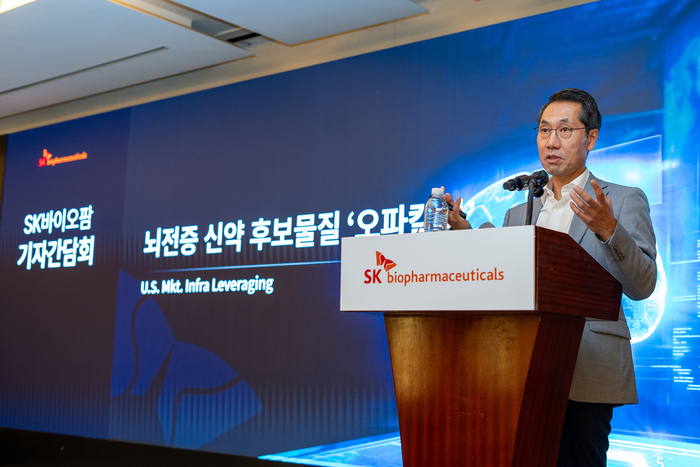
SK Biopharmaceuticals is acquiring global rights to the late-stage epilepsy drug candidate opakalim from U.S. biotech company Biohaven in a deal worth up to $795 million, or about 1.1 trillion KRW. The move is designed to move the company beyond its reliance on a single product, Xcopri, and build a multi-product commercial business in the United States.
“SK Biopharmaceuticals is entering an entirely new phase in which it will directly commercialize multiple products in the U.S. market,” Chief Executive Lee Dong-hoon said at a press briefing in Seoul on Aug. 26. “What matters is that we have secured a candidate approaching key readouts from a U.S. biotech listed on the New York Stock Exchange.”
Opakalim is a next-generation epilepsy drug candidate that selectively activates the Kv7.2/7.3 potassium channels in neurons, helping suppress abnormal neuronal overexcitability. It is being evaluated in two Phase 2/3 trials in adults with focal, or partial-onset, seizures. SK Biopharmaceuticals is targeting a U.S. launch as early as 2029, while the relevant composition-of-matter patent runs through 2039.
The transaction includes up to $795 million in upfront and development and regulatory milestone payments. SK Biopharmaceuticals will pay $400 million upfront in cash: $350 million at closing and a further $50 million one year later. The remaining $395 million is tied to development and regulatory milestones. Tiered royalties based on U.S. net sales will be paid separately, along with certain milestone and royalty payments to the asset's original developer, NoVus BioScience.
The agreement gives SK Biopharmaceuticals exclusive worldwide development and commercialization rights to opakalim, the broader Kv7 discovery platform and related compounds. Lee said the company had previously taken another acquisition target to the final stage last year before walking away.
“We spent another three years because we found something better—opakalim,” he said.
Tolerability is expected to be opakalim's key differentiator. The candidate selectively activates Kv7.2/7.3 channels without acting on GABA receptors, and has shown substantially lower rates of central nervous system side effects, such as drowsiness and dizziness, than competing drugs, according to the company.
Yoo Chang-ho, head of strategy and business development at SK Biopharmaceuticals, said the company's epilepsy team conducted extensive due diligence.
“Our organization has studied epilepsy for 30 years, and its review confirmed both a strong probability of success and clear points of differentiation,” Yoo said.
The company also expects commercial synergies with Xcopri, known generically as cenobamate. Xcopri has established a presence among severe epilepsy patients and epilepsy specialists because of its efficacy, while opakalim could expand prescribing among general neurologists because of its favorable tolerability profile.
SK Biopharmaceuticals said its existing U.S. commercial organization of about 150 employees could market both products with the addition of only 10 to 20 staff.
“Costs can be controlled, but revenue could become one plus one,” Lee said. “A single-product company and a multi-product company are in entirely different leagues.”
The company acknowledged that Xenon Pharmaceuticals' azetukalner, another Kv7-targeting epilepsy candidate, may reach the market one to two years earlier. Still, SK Biopharmaceuticals believes opakalim can establish a competitive advantage if its clinical profile proves at least comparable.
SK Biopharmaceuticals said it has the financial capacity to support the deal. It posted operating profit of 186.8 billion KRW in the first half of this year, held about 330 billion KRW in cash and had access to around 200 billion KRW in credit facilities.
Lee said the company remains open to additional acquisitions despite the deal's size.
“This acquisition does not leave us under cash pressure,” he said. “By the mid-2030s, we aim to become a pharmaceutical company with two blockbuster products.”
