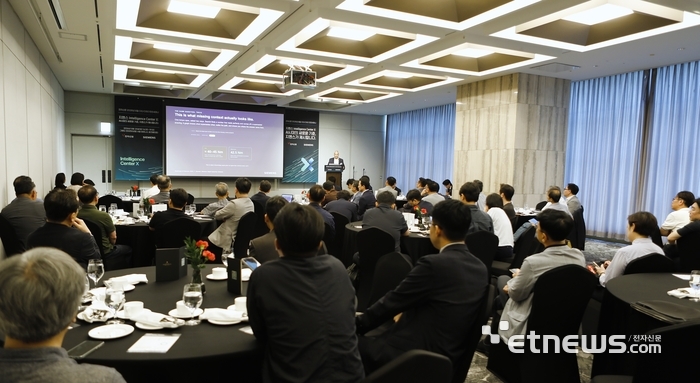







Siemens is rolling out its Intelligence Center X, or ICX, platform in South Korea to help companies move from isolated AI pilots to agentic AI-driven business transformation. The strategy is not simply to add AI features to existing systems, but to redesign work processes by connecting enterprise data, business rules and AI agents within a common operational context.
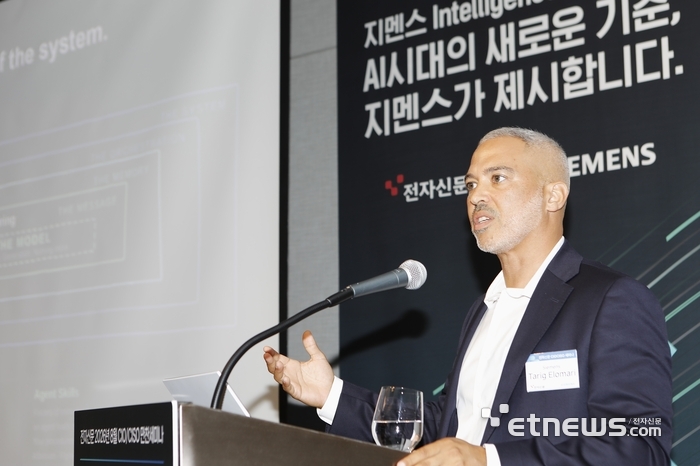
Siemens formally introduced ICX in Korea at the CIOCISO Dinner Seminar, hosted by Electronic Times in Seoul's Samseong-dong district on Aug. 25.
“Adding AI to existing processes alone does not constitute transformation,” said Tarik Elomari, head of strategic solutions at Siemens. “To create real value, companies must redesign their processes around agentic AI.”
The company is targeting what it calls the “pilot paradox” in enterprise AI: many companies have launched generative AI proof-of-concept projects, but relatively few have connected them to core production systems and day-to-day business operations.
Elomari identified several barriers to enterprise AI transformation: AI systems often lack an understanding of an organization's proprietary data, rules and domain knowledge; AI and machine-learning models remain disconnected from operational systems; AI is merely bolted onto legacy applications; human and AI-agent workflows are fragmented; and governance is not unified.
ICX is designed to bring together context, AI, applications, processes and governance in a single architecture. It structures enterprise data and operational relationships through ontologies, then enables AI models and agents to reason over that context.
The platform builds a shared industrial knowledge graph to provide context, uses domain-grounded AI models for reasoning, embeds AI capabilities into business applications and enables agents to act within company-defined rules. A governance layer is intended to provide traceability across the full lifecycle. Siemens says ICX combines its Mendix low-code platform with RapidMiner's Graph Studio and AI Studio to connect enterprise context, AI development and agent orchestration.
Elomari emphasized ICX's openness and Siemens' industrial expertise as key differentiators. “By applying open W3C standards, we reduce dependence on any single vendor,” he said. “Our ability to build enterprise ontologies based on Siemens' engineering expertise is what sets us apart.” Siemens' Graph Studio supports W3C standards including RDF, SPARQL, OWL and SHACL, designed to promote interoperability and limit vendor lock-in.
Siemens' longer-term objective is to create a “hybrid workforce” in which people and AI agents work together. Agents would handle routine analysis and information gathering, while employees retain responsibility for decisions that carry significant risk or accountability.
Lee Jun-ki, a professor at Yonsei University's Graduate School of Information, said enterprise AI needs more than retrieval-augmented generation, or RAG, if it is to influence real decision-making. Companies must also structure the relationships among internal concepts and data through ontologies, he said.
“AI projects will increasingly combine RAG with ontologies,” Lee said. “Rather than making ontology-building an end in itself, companies should begin with specific business problems and ensure that frontline teams take part directly.”