








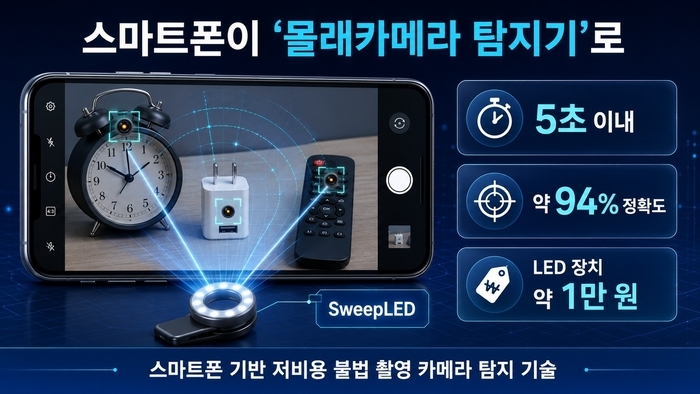
A low-cost hidden camera detection technology has been developed, allowing anyone without specialized equipment to use it easily. It utilizes smartphones for detecting hidden cameras. By simply attaching a low-cost LED device to a smartphone, hidden cameras in everyday objects like chargers, clocks, or remotes can be found in about 5 seconds with approximately 94% accuracy.
The Korea Advanced Institute of Science and Technology (KAIST, President Chung Hyung-Soon) announced on the 30th that Professor Joon Han's team from the School of Computing, in collaboration with the National University of Singapore (NUS) and Singapore Management University (SMU), developed “SweepLED,” a technology that detects hidden cameras by attaching an LED case to a smartphone.
Existing portable detectors for finding hidden cameras required users to visually confirm bright reflections from lenses, often leading to misidentifications where reflections from metal, glass, or glossy plastic were mistaken for camera lenses.
SweepLED eliminates this issue by analyzing reflection pattern changes on object surfaces while keeping the smartphone camera fixed and only altering the LED lighting direction.
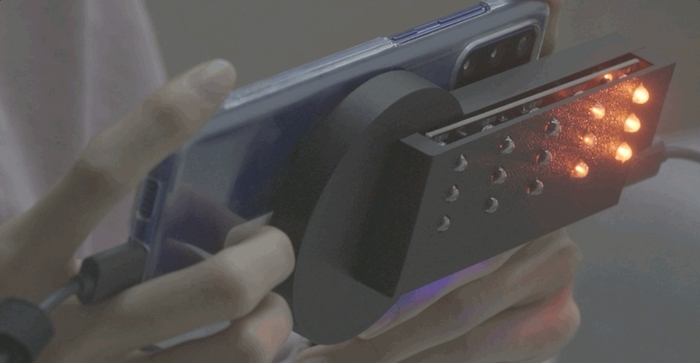
Unlike typical glossy object reflection points, which change position or disappear depending on the lighting direction, camera lenses produce uniquely distorted reflection patterns due to their internal lens, aperture, and image sensor structures, which this method leverages. The research team trained a deep learning-based video analysis model to recognize time-dependent reflection pattern changes, enabling the identification of camera lenses.
This approach allows for the stable detection of hidden camera lenses in everyday objects commonly found in accommodation spaces, such as chargers, alarm clocks, remote controls, and decorative items.
Performance evaluations conducted on 30 real-world objects achieved approximately 94% detection accuracy, with each object inspection taking less than 5 seconds.
The low-cost components also draw attention: the core LED case hardware costs under $7 (about KRW10,000), suggesting potential commercialization as a smartphone accessory or affordable consumer-grade detector.
Professor Han Joon stated, “Illegally installed cameras seriously threaten personal safety and privacy in everyday spaces. This research is meaningful as it demonstrates a practical detection technology accessible to non-experts by combining low-cost smartphone-based hardware (HW) with AI analysis.”
The study, with first author Yoon Jong-hyeok (KAIST Ph.D. candidate), was presented at ACM MobiSys 2026 on June 20.
